Document & Legal AI
AI contract review that shows its sources
The clause you need is somewhere in four thousand pages, and you cannot remember how it was worded. We build AI contract review and document search that finds text by meaning, summarises it and points to the page it came from. It does not give legal advice. A lawyer makes the final call.
Document & Legal AI
Sample scenario
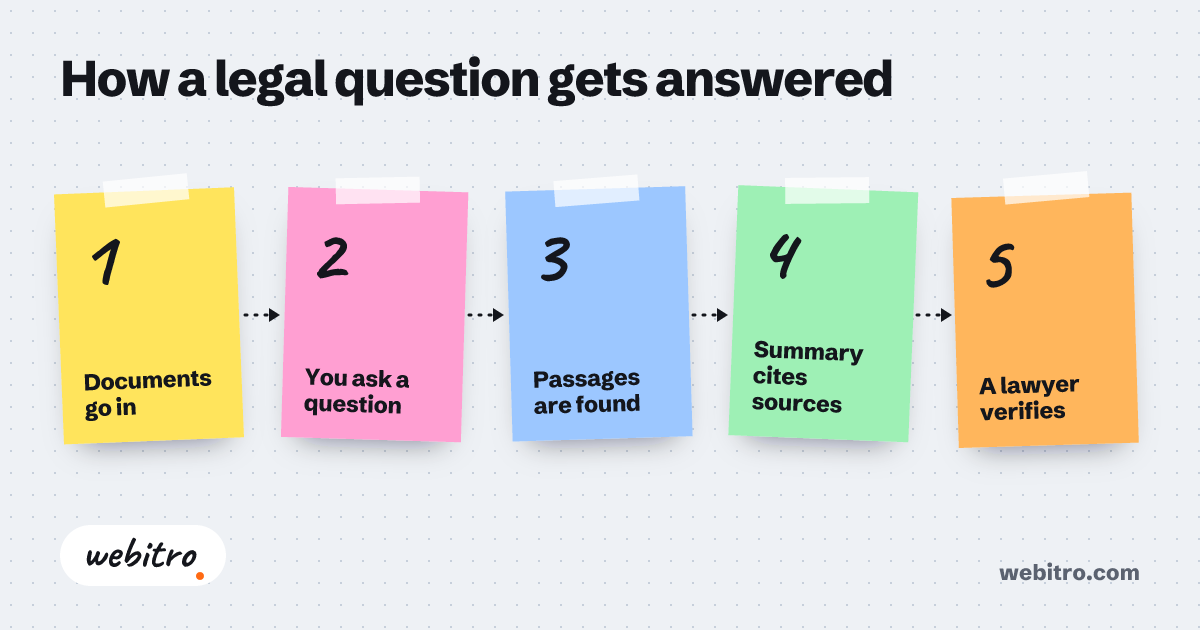
How a legal question gets answered
- 1Documents go in
- 2You ask a question
- 3Passages are found
- 4Summary cites sources
- 5A lawyer verifies
What the system does
Keyword search looks for the word you typed. Search for “penalty clause” and it will miss the clause that says “liquidated damages”. Semantic search recognises that both phrases point at the same idea and returns both.
- You ask in plain sentences across contracts, rulings and internal files: “Which agreements allow termination on less than thirty days’ notice?”
- It summarises a long contract or judgment in a few paragraphs and shows the page each point rests on.
- It checks a contract against your own playbook: missing clauses, unusual terms, one-sided rights.
AI document analysis software on your own hardware
Many firms do not want client files on someone else’s server. So we set the system up in one of three places: your own computer, your own server or the cloud.
We are not tied to one AI model. We can use a commercial cloud model. If documents must not leave the building, we install an open-source model that runs on your hardware. That route needs a stronger machine, and in return the data stays with you.
What if the AI cites a case that does not exist?
It can happen. A language model can produce a ruling that was never issued, complete with a plausible reference. This is what makes general chat tools risky for legal work.
We limit the risk in the build. The system is set up to answer only from the documents you loaded. The answer shows the document and page it rests on. When it finds nothing, it says “I found nothing on this in your documents”.
The output is still a draft. Opening the source and checking that it supports the point is the lawyer’s job. We build the system to make that check quick.
Legal AI for startups and small teams
A startup without in-house counsel signs the same kinds of paper repeatedly: NDAs, supplier terms, customer agreements, employment contracts. Legal AI for startups is useful here as a first reader. It flags the clause that differs from your standard terms, so the lawyer you pay by the hour starts with the points that matter.
It does not make a contract safe to sign. When the stakes are high, a lawyer reads it.
Off-the-shelf tool or a custom build?
Ready-made products for AI contract review are quick to start with and suit standard needs. If one of them covers you, we will tell you so.
A custom system earns its cost when the work depends on your own material: a contract archive going back years, your clause library, your internal opinions. We build on top of that archive. Whether it connects to your document management system is settled at the scope stage.
Our own product in this area is İctihatai, which analyses precedent rulings in Turkish law.
How a project runs
There are four steps. We listen and write down the scope. We show you the design, and no code is written until you approve it. We build the system and hand it over working. After delivery you get technical support around the clock.
Frequently asked questions
Does the system replace a lawyer?
No. It speeds up searching, summarising and comparing. It does not give legal advice, and it does not decide which ruling fits your case or whether a clause is acceptable. A lawyer makes those calls.
Are our documents used to train an AI model?
Not when the system runs on your own server or computer with an open-source model, because the documents never leave. If you prefer a cloud model, we go through the provider’s data terms with you before any work starts.
Can it read scanned PDFs and handwriting?
Scanned PDFs are converted to text and read, and errors rise as scan quality drops. Handwriting is unreliable, and we say so up front.
What decides the cost?
The number and type of documents, where the system runs, the software it connects to and the number of users. Running a model on your own hardware is a separate item. We have no standard price list. We listen to what you need and send an itemised quote.
Which languages and legal systems does it work with?
It works from the documents and sources you provide, so its coverage is as wide as that material. Our own product İctihatai is built for Turkish law. We test other languages on your sample documents before the build.
Related article
AI for contract review: what it catches, what it misses, how to check it
How AI for contract review works, where it helps and where it fails. A guide to clause extraction, invented citations, confidentiality and checking the output.