AI Orchestration
AI orchestration that turns one sentence into finished work
You ask for a report in one sentence. The AI orchestration system we build breaks that request into steps, sends each step to a model suited to it and shows you the cost before anything runs. Before delivery, the claims in the result are compared with their sources.
AI Orchestration
Sample scenario
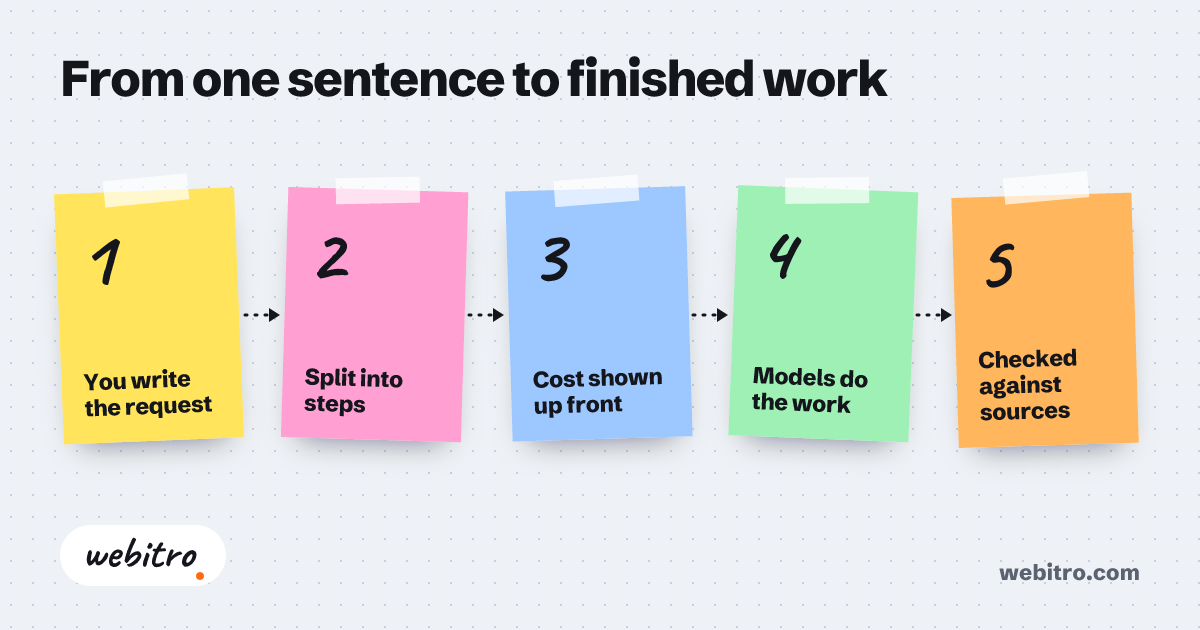
From one sentence to finished work
- 1You write the request
- 2Split into steps
- 3Cost shown up front
- 4Models do the work
- 5Checked against sources
What the system does
A chat window gives you one model and one answer. A request like “Compare our three main competitors on pricing over the last three years and write it up” is several jobs in one: research, reading, arithmetic, writing and checking.
Orchestration is the layer that puts those jobs in order. It splits the request, hands each part to a model or a tool and joins the results. You still type one sentence.
How a request moves through it
You can read the plan and change it. Expensive steps can be set to wait for your approval.
- Plan: the request is broken into steps, each assigned to a model.
- Cost: the estimated spend and time are shown before work starts.
- Run: steps execute in sequence or side by side.
- Verify: claims are compared with their sources, and anything unsupported is flagged.
- Deliver: the finished work arrives with its list of sources.
Multi agent orchestration: why one model is not enough
One model reads long documents well and costs a lot. Another is fast and cheap. Some write better in your language, some are stronger at code. Some data should never leave your building, so that step goes to an open-source model on your own hardware.
In multi agent orchestration each step has its own agent, with its own model, instructions and tools. Sending everything to the most expensive model inflates the bill, and sending everything to the cheapest lowers quality. Splitting the work also lets one model review what another wrote.
Seeing the cost before the work runs
AI models charge by usage. In a job with many steps that total can grow without anyone noticing. So while it plans, the system estimates the cost of each step and shows you the sum.
A spending cap can be set as well. When a job gets close to it, the system stops and asks. The estimate is not an invoice, because nobody can know in advance exactly how much a model will write.
What verification catches and what it misses
Language models can state wrong things in a confident voice and cite sources that do not exist. Before delivery, a verification step compares every claim with the source it rests on. If the source does not say it, the claim is removed or clearly marked.
There is a limit. Verification checks whether the source says what the text says. It cannot tell you that the source itself is wrong. In law, health or finance, the final read should be done by a person who knows the field.
Who it suits
If you ask a few questions a day, an ordinary chat tool will serve you well. We install the system on your own computer, your server or in the cloud. Our own product Promtexpress produces ready-to-use prompts for more than 60 AI engines.
- Teams that regularly produce research reports, market analyses or proposal documents.
- Firms that have to read, summarise and compare hundreds of documents.
- Software companies adding a multi-step AI feature to their own product.
Frequently asked questions
How is this different from using a single chat tool?
A chat tool gives one answer from one model. An orchestration system splits the request into steps, spreads them across several models and checks the result against sources.
Which AI models do you use?
We are not tied to one. Commercial cloud models and open-source models running on your hardware can sit in the same system. We choose a model for each step with you and can swap it later.
What decides the price?
The build depends on the number of steps, the models and data sources to connect, and how strict verification has to be. Usage adds the model providers’ fees or the running cost of your own hardware. We have no standard price list. We listen to what you need and send an itemised quote.
Can it run without my data leaving the company?
Yes. We can install the system on your own server and give sensitive steps to open-source models on your hardware, which then limits the models available. During design we write down which data may go where.
What happens if the system produces something false?
The verification step exists to catch claims that have no support in the sources. No method brings errors to zero. Every result comes with its source list, and we recommend a human final read on anything critical.
Related article
What is AI orchestration? Frameworks, models and honest limits
A plain guide to running one job across several AI models: how the steps are split, what LLM orchestration frameworks do, how models differ and where it fails.