AI Agents
Custom AI agent development, built around your work
Custom AI agent development means the agent is built on your data, your tools and your rules. It researches, prepares the decision and carries out the work you approve. We agree at the start which steps it takes alone and which ones it brings to you.
AI Agents
Sample scenario
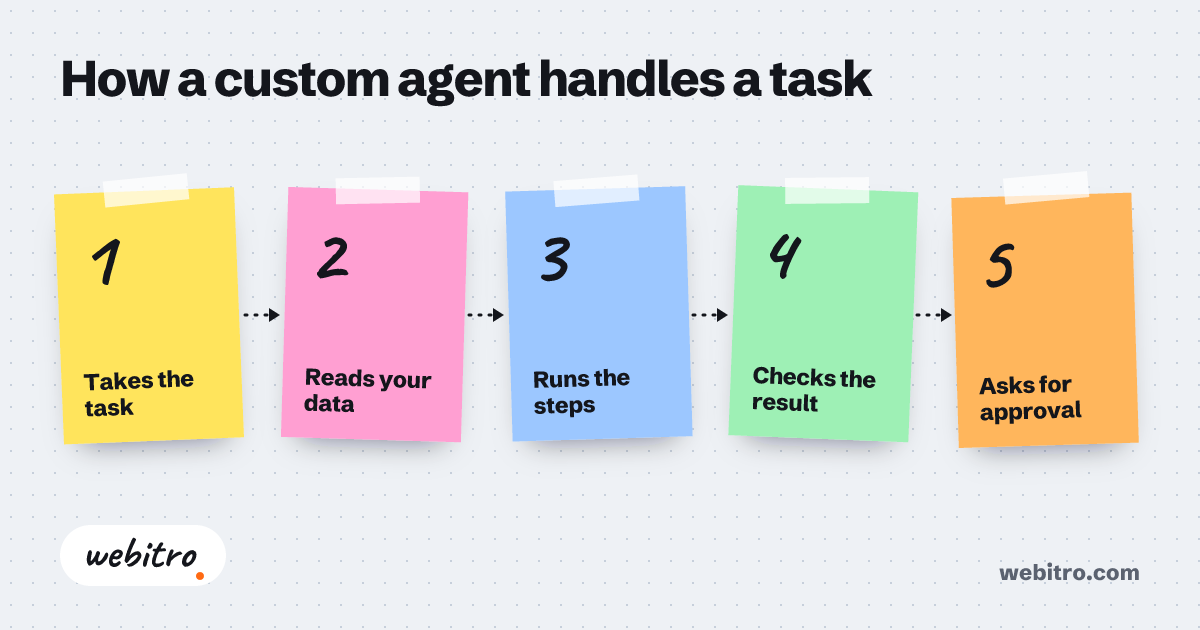
How a custom agent handles a task
- 1Takes the task
- 2Reads your data
- 3Runs the steps
- 4Checks the result
- 5Asks for approval
What an agent does that a chatbot does not
An agent is software that orders its own steps towards a goal and uses tools along the way. A chatbot writes an answer and stops. An agent carries the job further.
Take one request: “Find this week’s overdue invoices and draft a reminder for each customer.” The agent opens your accounting records, pulls the list and writes a separate draft for every customer. Then it stops and shows you the drafts. Sending them is your call.
The work an agent can take on
Agents do best on work that repeats often and follows clear rules.
- Research: scans sources on a topic you set and gathers the findings, with references, in one note.
- Decision prep: compares quotes, suppliers or candidates against your criteria and writes down its reasoning.
- Document work: reads contracts, invoices and forms, extracts what you need and flags gaps or contradictions.
- Operations: watches orders, stock or support tickets and alerts the right person when something breaks a rule.
- Record keeping: turns meeting notes into tasks and enters them in your CRM or project tool.
How the build goes
We work in four steps. First we listen: who does the job today and where they get stuck. We suggest starting with one workflow, because a small agent is easier to measure.
The second step is design. We put in writing which data the agent can reach, which tools it uses and where it must stop. No code is written until you approve that document.
During development we give the agent a set of jobs you have already done by hand and put its output next to yours. At handover you receive a working agent, followed by round-the-clock technical support and consulting.
Permissions, approval and logs
An agent can misread a request or guess when information is missing. So every agent gets narrow permissions and reaches only the systems its job needs.
Steps that are hard to undo, such as moving money or deleting records, wait for a person to approve them. Every step is logged. If a result looks odd, the log shows which data the agent read and why it decided as it did.
Which model, and where it runs
We are not tied to one AI model. Depending on the job we choose a commercial cloud model or an open-source model running on your own hardware. With sensitive data the second route is often better, because the data stays in your environment.
The agent can run on your own computer, your own server or in the cloud.
Choosing an AI agent development company
Ask any AI agent development company three questions. Can they show you how the agent failed in testing? Will it still work if the model behind it is replaced? Who looks after it once it is live?
We will also tell you when an agent is the wrong tool. A task whose steps never change is cheaper and more predictable as plain automation. A task nobody can describe clearly has to be written down before any agent can do it.
Frequently asked questions
What decides AI agent development cost?
Three things: how many workflows the agent covers, how many systems it connects to, and which model it uses and where that model runs. A cloud model adds a usage cost, while a model on your own hardware shifts the cost to the hardware. We have no standard price list. You get an itemised quote after we hear what you need.
Can the agent connect to the software we already use?
Usually yes, if the software has an API or some way to export data. If a system cannot be connected, you hear about it before any code is written.
Does our data go to a third-party model?
That depends on your choice. With a commercial cloud model, the data the agent processes is sent to that provider. If you do not want data to leave, we build the agent on an open-source model that runs on your own hardware.
What happens if the agent does something wrong?
The agent does not take hard-to-undo steps alone. It waits for your approval. Everything else it does is logged, so a mistake can be found and corrected.
Who runs the agent after handover?
Your own team runs it day to day, and no programming knowledge is needed for that. We step in when you need a new rule, a new connection or a change of model.
Related article
What are AI agents? What they can and can’t do for your business
An AI agent is software that plans its own steps and uses tools to reach a goal. Realistic business use cases, current limits and how to set one up safely.