AI · · 3 min read · Webitro team
What are AI agents? What they can and can’t do for your business
An AI agent is software that plans its own steps and uses tools to reach a goal. Realistic business use cases, current limits and how to set one up safely.
How an AI agent carries out a task
- 1Receives the goal
- 2Plans the steps
- 3Uses its tools
- 4Checks the result
- 5Asks on critical steps
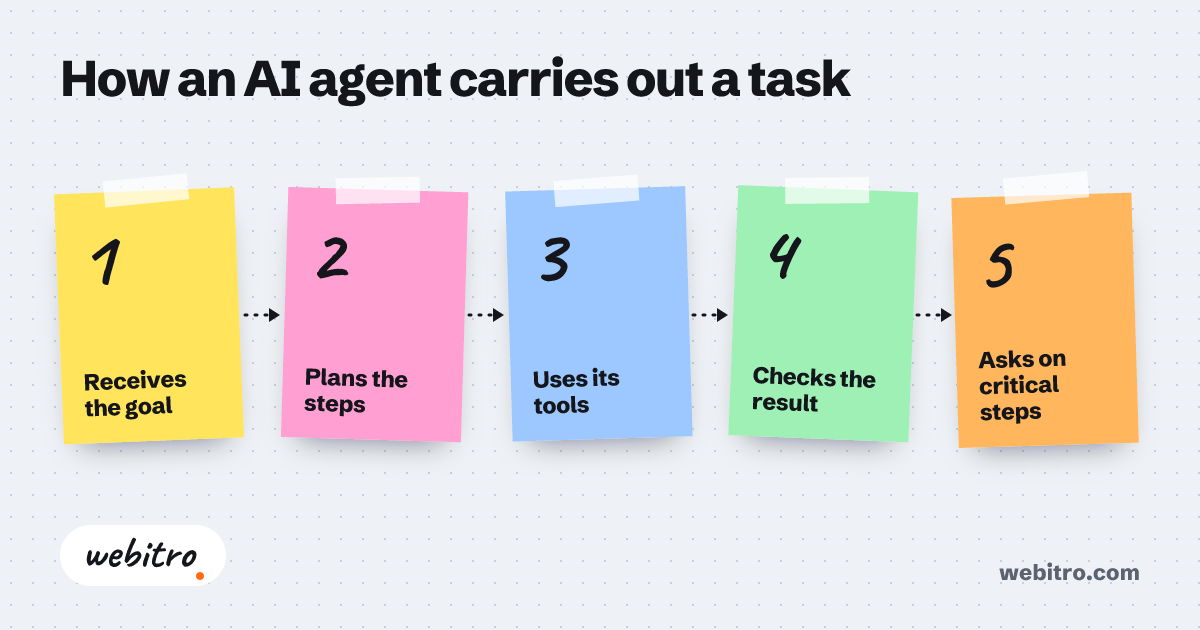
Chatbots answer questions; AI agents get work done. An agent plans its own steps to reach the goal it’s given, uses tools when needed, querying a database, drafting an email, entering a record into a system, and checks the result.
Chatbot vs. agent
A classic chatbot answers “Where is my order?” with a canned reply. An agent connects to the order system, finds the order, checks the shipping status and writes the customer an up-to-date answer. The difference is that an agent can reach real systems and carry out several steps on its own.
Realistic use cases for businesses
- Customer messaging: answering questions from WhatsApp or your website, taking bookings and orders.
- Sales prep: researching and listing potential customers and drafting personalised first messages.
- Document work: reading contracts, invoices or forms, extracting key details and flagging risky clauses.
- Content: drafting product descriptions, social media posts and first versions of reports.
- Operations: tracking stock, orders and notifications and alerting the right person when needed.
What they can’t do well (yet)
Agents make mistakes: they can misunderstand, guess with incomplete information or produce a confident-sounding wrong answer. That’s why high-stakes steps, moving money, legal decisions, irreversible commitments to customers, shouldn’t be left to an agent without human approval. A good setup defines up front what the agent may do on its own and what it must submit for approval.
Principles of a safe agent setup
- Limited access: the agent only reaches the systems and data its job requires.
- Human approval: critical steps go through a person.
- Logging: every action the agent takes is recorded so it can be reviewed later.
- Data privacy: for sensitive data, models that run locally or on your own server can be used.
Where to start
The best starting point is a task that repeats often, follows clear rules and where mistakes are easy to spot. Putting an agent into a single workflow and measuring the results gives you a clear picture before you take bigger steps. At Webitro we build agents this way, around your business, one step at a time.
Services: Custom AI agent development, built around your work
AI Agents
Sample scenario
Frequently asked questions
What are the best AI agents for business?
There is no single list, because the best AI agents for business depend on the job. A good agent can reach your data, works with the tools you already use, stops and asks when it is unsure, and logs everything it does. Judge a product by how it performs on a few real cases from your own work.
What determines AI agent development cost?
AI agent development cost depends on how many workflows the agent covers, how many systems it has to connect to and how much testing the task demands. The model matters too: a cloud model is billed by usage, while a model on your own hardware needs that hardware. A fixed price list makes little sense for this kind of work, so ask for an itemised quote.
Is an AI assistant the same as an AI agent?
Not quite, though the line is not sharp. An assistant mostly talks with you and helps when you ask. An agent takes a goal and carries out several steps without being told each one. The same software can act as an assistant in one job and as an agent in another.
Can I build an agent without writing code?
For a simple one, yes. Ready-made platforms let you combine a model, instructions and a few common tools without programming. An agent that has to reach your own systems, follow your own rules and keep a reliable log usually needs custom software.
How do I know an agent is working well?
Prepare a set of jobs you have already done by hand and compare the agent’s output with yours. Look at how often it reaches the right result, where it stops to ask and how easy its mistakes are to spot. Repeat the check at intervals after the agent goes live.