AIO, GEO, SEO
Generative engine optimization built on sound technical SEO
Your customers still type questions into Google, and more of them now ask an AI assistant too. Generative engine optimization, GEO for short, makes a site easy for both to find, read and cite. We fix the technical base, add structured data and rewrite pages so the answer is easy to lift. We promise no rankings or citations, because nobody honestly can.
AIO, GEO, SEO
Sample scenario
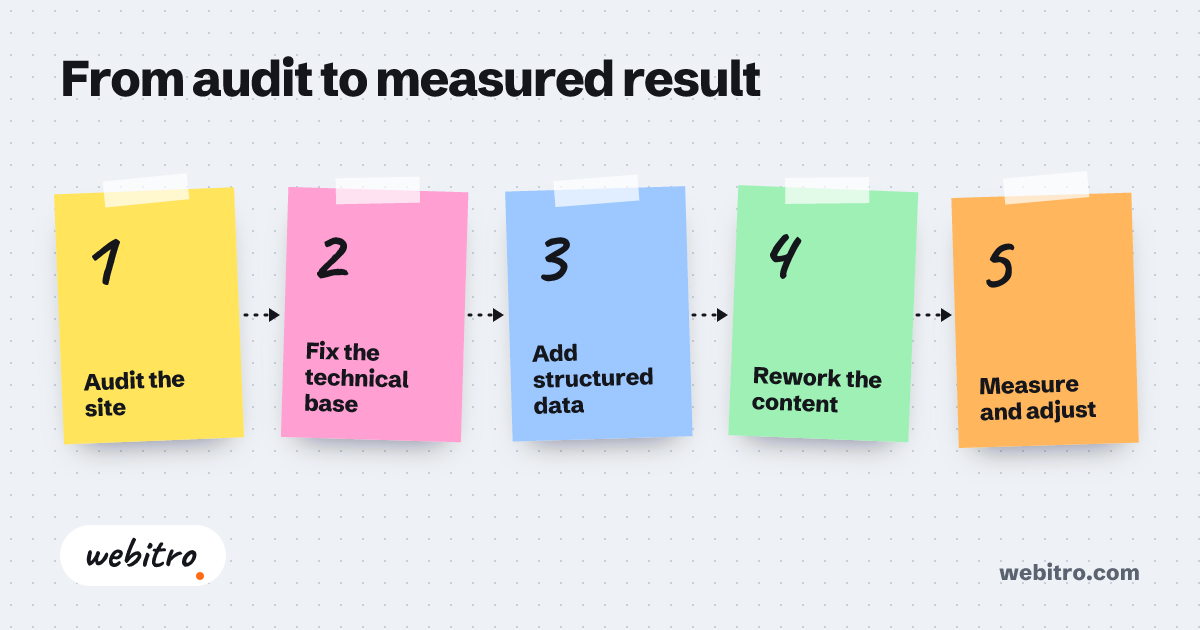
From audit to measured result
- 1Audit the site
- 2Fix the technical base
- 3Add structured data
- 4Rework the content
- 5Measure and adjust
What our AI search optimization services cover
Our AI search optimization services rest on the same foundation as classic SEO. Google states that its AI features have no technical requirements beyond those of ordinary Search. A page that cannot be crawled and indexed appears in neither.
The work has three parts.
- Technical base: crawling, indexing, page speed, mobile rendering and internal links.
- Structured data: schema markup that tells machines what a page is about, such as an organisation, a product or an article.
- Content: each page answers a real question clearly, with the answer near the top.
It starts with a technical SEO audit
A technical SEO audit checks whether search engines and AI crawlers can reach your site, and what they see when they do. We look at what your robots file blocks, whether important pages are indexed, how fast pages load and whether the content sits in the HTML or only appears after scripts run.
You receive a list of findings ordered by effect, each with what is wrong, why it matters and how to fix it. A structural problem, such as thousands of near-duplicate pages, has to be solved before anything else.
Structured data and its limits
Structured data is code that states plainly what is on the page: who published it, what the product is, which question is answered. Google recommends the JSON-LD format for it.
Two limits apply. Markup must describe what a visitor can see on the page, and marking up content that is not there breaks Google’s guidelines. Correct markup makes a page eligible for rich results without guaranteeing them.
Content an answer engine can quote
This part often goes by the name answer engine optimization, or AEO. An assistant that cites a source needs a passage it can lift cleanly. A page that spends three paragraphs on introduction is harder to use than one that answers in its first two sentences.
So we restructure pages. Each page or section takes one question, with the direct answer first and the detail after. We also make sure your company name and what you do are stated the same way across the site.
What is known and what is not
This is a young field and its practices are still forming. Several answer engines, OpenAI and Anthropic among them, publish the names of their crawlers and how robots rules apply to them, so you can decide which may read your site. OpenAI uses one crawler for search and a separate one for model training, and each can be blocked on its own.
What is not documented is any formula for being cited. Answers vary between users and between runs, and the companies do not publish what earns a mention. Anyone selling guaranteed citations is guessing. We tell you which of our recommendations rest on evidence and which on reasonable judgement.
How we work and how we report
We listen first, then audit, then present the plan. Nothing changes on your site until you approve it. We apply the fixes ourselves or hand your developers a task list. Afterwards we measure with Search Console and your own analytics, and you see the same figures we do.
Frequently asked questions
Can you guarantee a first-page ranking or a citation in AI answers?
No, and no one can. Search engines decide rankings and AI systems decide citations, and neither publishes a formula. We remove the obstacles that keep a site from being crawled, understood and quoted.
What is the difference between SEO and GEO?
SEO aims at a place in the list of search results. GEO aims at being cited as a source when an AI system writes an answer. The technical foundation is shared.
Do I need a special file or markup for AI engines?
Google says no new machine-readable files or special markup are needed for its AI features. The page has to be indexed, readable and not blocked. The documented way to control AI crawlers is the robots file.
How long before results show?
Technical fixes are picked up when the site is crawled again, which can take days or weeks. Changes in visibility take longer. We will not give a date we cannot stand behind.
What decides the price?
The size of the site, how many problems the audit finds, whether we or your team apply the fixes, and how much content needs rewriting. We have no standard price list and send an itemised quote after the first conversation.
Related article
Generative engine optimization and answer engines: what is known
What GEO, AEO and AIO mean, how AI answer engines reach your pages, what the official documentation says and which popular claims are still guesswork.