Guide · · 6 min read · Webitro team
Generative engine optimization and answer engines: what is known
What GEO, AEO and AIO mean, how AI answer engines reach your pages, what the official documentation says and which popular claims are still guesswork.
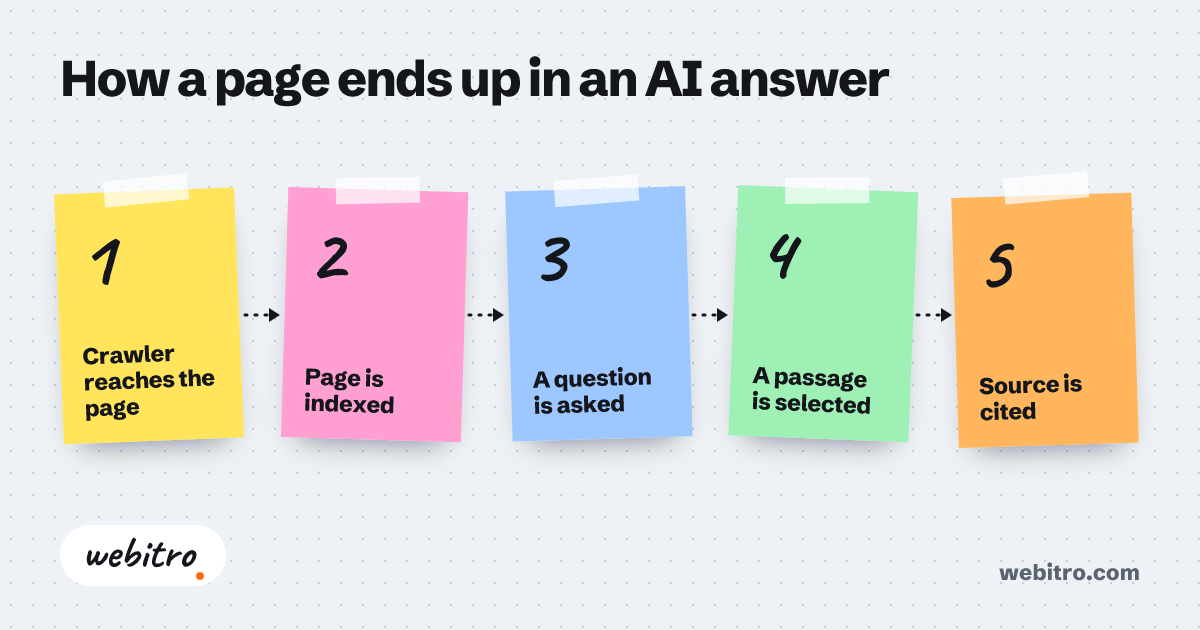
How a page ends up in an AI answer
- 1Crawler reaches the page
- 2Page is indexed
- 3A question is asked
- 4A passage is selected
- 5Source is cited
Ask an AI assistant to recommend an accounting tool for a small business and it replies with a paragraph, a few names and sometimes links to its sources. Site owners have noticed, and a new vocabulary has grown up around the wish to be one of those sources. Generative engine optimization is one of the terms heard most often. This article separates what the search and AI companies have documented from what is still guesswork.
GEO, AEO and AIO: three names, overlapping ideas
Search engine optimisation, SEO, is the established practice of helping a page rank in a list of results. The newer terms describe the same effort aimed at systems that write an answer.
GEO is about content being used and cited when a generative AI system composes a reply. AEO, answer engine optimization, is about shaping content so that a system can extract a direct answer from it. That term is older and was already in use for featured snippets and voice assistants. AIO is used loosely for AI optimisation in general. Some people use the same letters for Google’s AI Overviews, which is where the confusion starts.
In practice the three overlap almost entirely. Nobody owns the definitions, and two agencies may mean different things by the same word. When you read an offer, ask what work is behind the label.
How an answer engine reaches your page
An assistant that answers with sources has to read pages somehow. Some run their own crawlers. OpenAI documents a crawler that builds the index for ChatGPT’s search feature and a separate one that collects training data. Anthropic documents a similar split for Claude. Each crawler has its own name, and each can be allowed or blocked in your robots file.
Google’s AI features draw on the same index as ordinary Google Search. According to Google, a page needs to be indexed and eligible to be shown with a snippet, and nothing more.
The consequence is practical. If your robots file blocks a search crawler, or a page is marked noindex, that page will generally not be used as a source by the system behind it. OpenAI says so directly: sites that opt out of its search crawler are not shown in ChatGPT search answers, though they may still appear as plain navigational links.
What the documentation says
The official sources say less than most articles on the subject suggest. Most of what they do say is old advice.
- Google states that there are no additional requirements and no special optimisations for appearing in AI Overviews or AI Mode. The fundamentals of Search apply.
- Google also states that no new machine-readable files, AI text files or special schema markup are needed for those features.
- Structured data helps Google understand a page. It must match what is visible on the page, and it makes a page eligible for rich results without guaranteeing them.
- Standard controls such as nosnippet and noindex also limit how content appears in Google’s AI features.
- Training crawlers and search crawlers are separate. Blocking one does not block the other.
What is still guesswork
The companies behind the answer engines do not publish a formula for what earns a citation. Much of the advice in circulation comes from people testing prompts and looking for patterns. Some of it may be right. Little of it has been confirmed by the people who build the systems.
Answers are also unstable. The same question asked twice can produce different wording and different sources, and results can differ from one user to the next. A screenshot showing your brand in an answer proves that it happened once.
Be careful with three kinds of claim: a guaranteed mention in AI answers, a special file that makes AI systems prefer your site, and a tool that reports your exact share of AI citations. Google has said it needs no special file for its AI features. Tracking tools sample a set of prompts, which is useful as a trend and weak as a precise number.
What you can sensibly do
With so little confirmed, the reasonable plan is to do the documented things well and add the low-risk habits that also help human readers.
- Check that search crawlers and AI search crawlers are not blocked by accident in your robots file.
- Make sure the main content is in the page’s HTML and that important pages are indexed.
- Put the direct answer at the top of the page and the explanation after it.
- Use headings that state which question each section answers.
- Add structured data that matches the visible content.
- State who you are, what you do and where you operate in the same words across the site.
- Publish things worth citing: your own figures, clear definitions, first-hand experience.
How to tell whether it is working
Measurement is the weakest part of the field. Google includes visits from its AI features in the overall performance figures in Search Console. Visits that arrive through a link in an assistant’s answer may show up in your analytics as referrals from that assistant.
A simple manual check is still useful. Write down ten questions your customers really ask, put them to the assistants once a month and note if you are mentioned and what is said about you. It is a rough method, and it does not pretend to be anything else.
The field will settle, and some of today’s advice will turn out to be wrong. Work that makes a site easier to crawl and clearer to read is unlikely to be among it. If you would like that work done for you, it is what we do at Webitro. We start with a technical audit and make no promises about rankings.
Services: Generative engine optimization built on sound technical SEO
AIO, GEO, SEO
Sample scenario
Frequently asked questions
What is generative engine optimization?
It is the practice of making a website easy for AI systems to find, understand and cite when they write an answer. It builds on ordinary SEO and adds attention to clear, answer-first writing. The field is young and its methods are not settled.
Is answer engine optimization different from SEO?
The difference is one of emphasis. Both depend on a site being crawlable, indexed and clearly written. The newer term puts more weight on giving a direct, quotable answer.
Do I need an llms.txt file?
Not for Google, which states that no special AI text files are needed for its AI features. The file is a community proposal, and adding one does no harm. Treat it as optional.
Should I block AI crawlers?
It depends on what you want. Blocking a training crawler keeps your future content out of model training and does not affect search. Blocking a search crawler removes you from the sources that assistant cites. The two are separate settings in the robots file.
Can anyone guarantee that an AI will cite my site?
No. The AI system chooses its sources, and no formula explaining the choice has been published. What can be done is to make the site easier to crawl and understand and to write the answer clearly.