AI Automation Agency: What It Does and How to Hire One
An AI automation agency is a software studio that designs, builds and runs custom automation for a business, instead of selling a subscription to someone else's tool. You describe the repetitive work that eats your team's week, and the agency turns it into software that runs on its own. Webitro works that way.
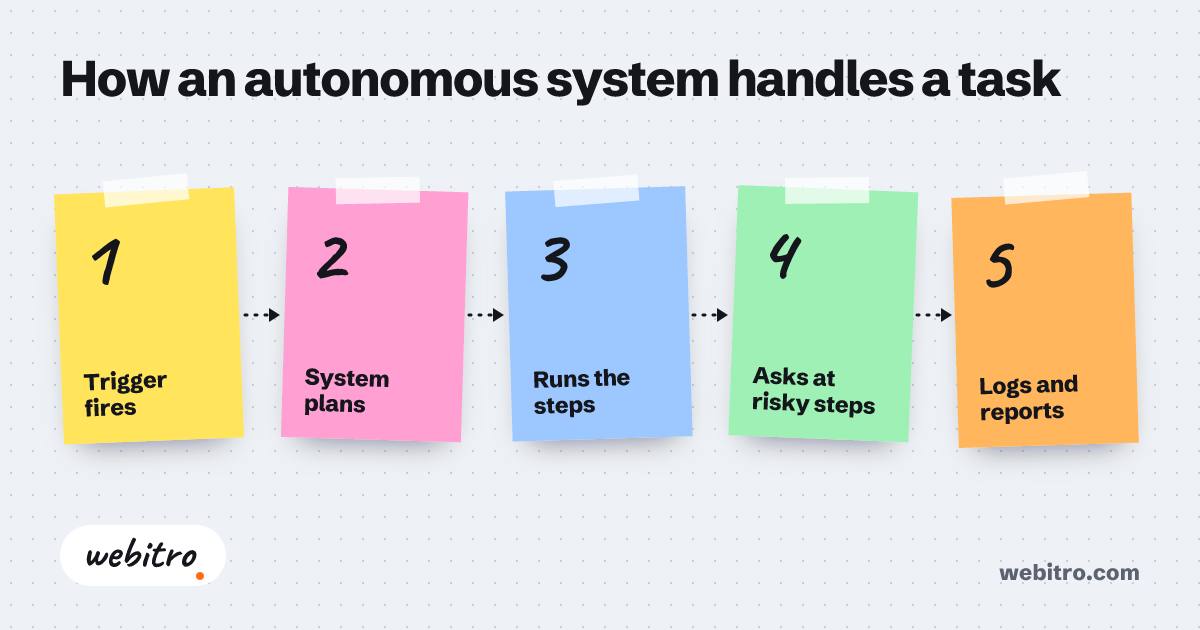
- An automation build splits every decision into rule-based code or a model, depending on whether human-style judgement is required.
- Running costs track the volume of work passing through the system, while build cost tracks the complexity of the decisions involved.
- With a subscription you rent capability; with a custom build the software remains your own asset.
Video summary of this article
Watch this video on its own page
Video transcript
An artificial intelligence automation agency designs, builds and runs custom automation for a business instead of selling a subscription to a tool.
An agency maps manual steps, rebuilds them as software, and uses artificial intelligence only where a model beats a fixed rule. Clear rules become ordinary code, while language or context goes to a model.
A project moves through discovery, written scope, and a prototype on your real data. Then hardening, testing, and launch with a support window.
Off the shelf tools fit standard processes, while custom software fits your own workflow. A subscription rents capability, but a custom build remains your own asset.
Cost depends mainly on how many decisions the system makes, how messy the data is, and how many systems it talks to. Running costs track how many documents, messages or records pass through each month.
Before signing, settle who owns the code, how model changes are handled, and who supports the system. After launch, log decisions, review them monthly, and correct drift.
You can find the full details in the article.
If your process follows fixed, repetitive steps, it helps to know where AI automation and RPA differ before you commit to an approach.
What an AI automation agency actually does
An AI automation agency maps the manual steps in a business process, rebuilds them as software, and uses AI only where a model genuinely beats a fixed rule.
Search for an AI automation agency and you'll mostly find integrators. They connect tools you already pay for — a form here, a spreadsheet there, a chat widget on top — and call the result automation. That approach copes with simple flows well enough, until a process throws an exception.
A real build starts with the process, not the software. We sit with the team, watch how a quote gets drafted, how a lead gets qualified, how an invoice gets checked, and note every judgement a person makes along the way.
Those judgements then split in two. Anything with a clear rule becomes ordinary code: quick to run, predictable, cheap to maintain. Anything needing language, context or pattern recognition goes to a model.
That split is the real work. Get it wrong and you either pay model fees for tasks a script could handle, or you hard-code rules that collapse on the first unusual customer email.
You'll also hear the term AI agent used loosely for almost anything with a model inside it. A true agent takes a goal and chooses its own steps, which is powerful and much harder to keep predictable. Most business processes don't need that freedom.
How a project runs, from first call to handover
A project moves through a discovery call, a written scope, a prototype built on your real data, hardening and testing, then launch with a support window.
The first call is a conversation rather than a pitch. We ask what your team does by hand each week, how long each task takes, and what happens when it fails. If automation is the wrong answer, we'll say so.
Then comes a written scope. It lists every task the system will handle, what falls outside it, and who owns each decision. This document matters more than any demo, because it's where expectations get fixed.
Next we build a prototype against your own data: a sample of your inbox, your product catalogue, your contracts. Prototypes look rough, and that's deliberate — they show whether the approach survives contact with reality before anyone funds a full build.
If the prototype behaves, we harden it. Error handling, logging, retries, plus a simple way for your team to see what the system did and why. Then launch, then a support window while the odd edge case surfaces.
Custom software or an off-the-shelf tool?
Off-the-shelf tools fit standard processes, while custom software pays off when your workflow, data rules or customer promises don't fit a template.
Plenty of businesses should buy a tool and stop there. If your process matches what thousands of other companies already do, a subscription will be cheaper and quicker than anything worth building from scratch.
Custom work earns its place when the process is genuinely yours. Perhaps pricing depends on factors no off-the-shelf product models. Perhaps data can't leave your own server. Perhaps the customer journey itself is what sets you apart.
Ownership is the other half of the argument. A subscription rents you capability: when the vendor changes direction, raises prices or shuts down, your workflow leaves with them. A custom build stays on your side of the fence.
There's a sensible middle path too. Orchestration puts a custom layer over tools you already use, so each one does what it's good at and the hand-offs stop being manual. It's often the quickest route to a visible result.
What drives the cost of an AI automation project
Cost depends mainly on how many decisions the system makes, how messy the source data is, and how many existing systems it has to talk to.
Cost follows complexity, not ambition. The biggest driver is how many separate decisions the system has to make, because each one needs its own logic, its own testing and its own failure handling.
Data quality comes next. If the inputs arrive in one tidy format, the work is straightforward. If they arrive as scanned PDFs, forwarded emails and a WhatsApp group, most of the budget goes on reading and cleaning before any clever part begins.
Integrations add weight as well. Every system we touch — your CRM, accounts package, stock list, website — brings its own permissions, quirks and rate limits, and each one needs testing to be sure nothing else breaks.
Running costs behave differently. They track usage: how many documents, messages or records pass through each month. So a system can be modest to build and busy to run, or the reverse.
A common assumption worth correcting is that AI is expensive to run everywhere. For a lot of tasks, a plain rule-based step does the job at almost no cost, and a good agency will say so rather than sell you a model.
What to ask before you sign
Before signing, settle who owns the code, how model changes are handled, how you'll audit decisions, and who supports the system out of hours.
Ask who owns the code and the prompts. If the answer is anything other than you, that's a problem worth pausing on, because it decides what you can change later without the agency's permission.
Ask what happens when a model provider retires a version or moves its pricing. Every serious build should assume the underlying model will be swapped at some point, so the system needs to be written for that day.
Ask how you'll see what it did. A system that makes decisions quietly in the dark is worse than a manual process, because nobody notices the moment it starts getting things wrong.
One more question: who fixes it at the weekend? If the automation touches customer-facing work, you need a clear answer about support hours and what happens outside them.
Finally, ask about the handover. You want documentation, access, and someone on your own team who can adjust a rule without booking a meeting. If that isn't on offer, keep looking.
Keeping it running after launch
Keeping the system reliable means logging decisions, reviewing them monthly, and correcting drift before small errors become normal.
Launch is the midpoint, not the finish. The first weeks of live traffic surface inputs nobody predicted: a supplier who writes in a different format, a customer who replies to the wrong thread.
So we build in feedback. Every decision the system makes gets logged with enough context to review it, and your team needs a simple way to flag anything that looks wrong.
Models drift and suppliers change their formats. A short review each month catches most of it: what got through, what got stuck, what took longer than expected. Small corrections there keep the whole system honest.
It also helps to expect a second round. Once the first process runs quietly, the team usually spots the next one worth automating, and the groundwork is already in place.
Our AI automation service is built for exactly this: systems shaped around your process and handed over already working.
Frequently Asked Questions
How long does an AI automation project take?
It varies with how many decisions the system has to make and how messy your data is. One well-defined task is far less work than a process with a dozen exceptions, so we scope it before quoting anything.
Do we need clean, well-organised data before starting?
No, but it changes the shape of the project. If your data is scattered, part of the job becomes reading and tidying it, which is work we can take on. Better to know that on day one than halfway through.
Will automation replace our staff?
Not usually. The tasks that disappear are the repetitive ones people complain about, while judgement, relationships and exceptions stay human. Most teams end up handling more volume with the same headcount.
What's the difference between an AI automation agency and a no-code integrator?
An integrator connects tools that already exist; a studio writes software where those tools fall short. Some jobs need only the first. Others stall until somebody builds the missing piece.
Can you work with the systems we already use?
Yes, usually. We'd rather extend what you have than replace it, provided the existing tools let something in. If they don't, we'll tell you what that means for the build.