AI Lead Generation Software: What It Is and How to Commission One
AI lead generation software is a system that captures, scores and follows up on potential customers automatically, using models and automation rather than a static list of names. It sits in front of your CRM, decides which enquiries deserve attention and handles the first reply without anyone watching the inbox.
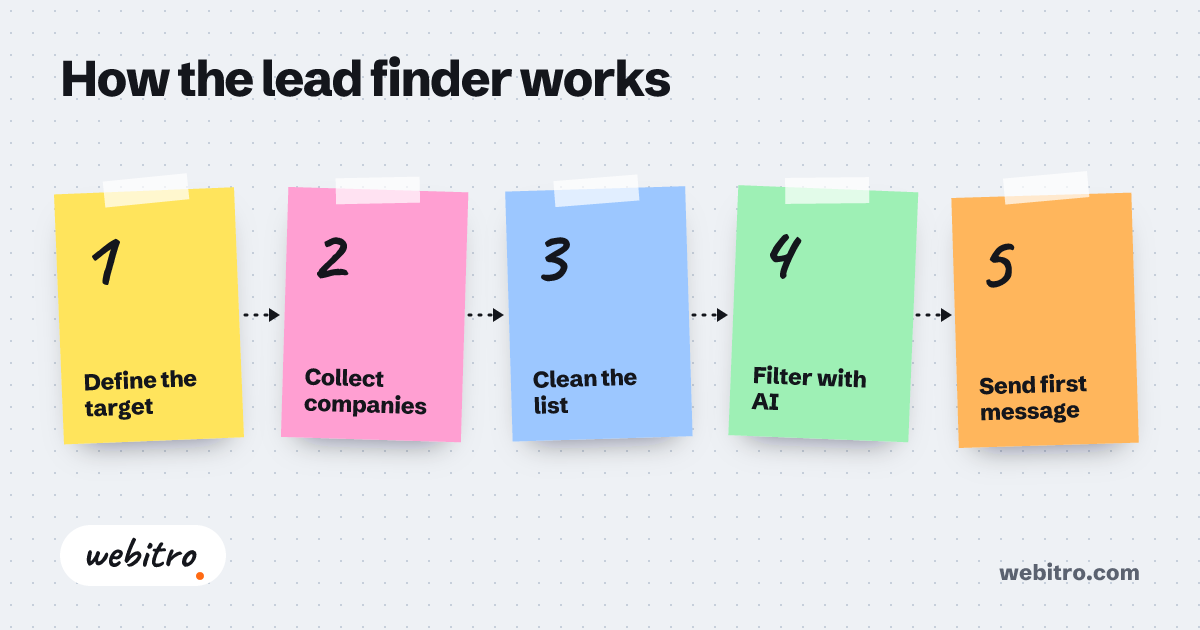
- A scoring model only pays for itself when the highest-ranked leads are worked first, so routing rules matter as much as the model itself.
- Most lead generation builds fail at the data layer — duplicated records, missing source tags, messy form fields — rather than at the model.
- Scoring trained on a company's own won and lost deals outperforms a generic score because fit is specific to each business.
Video summary of this article
Watch this video on its own page
Video transcript
AI lead generation software captures, scores and follows up on potential customers automatically, using models rather than a static list.
It collects enquiries, scores each one, and puts the strongest first. The system replies within seconds and asks qualifying questions. It offers a call slot when answers fit.
A CRM records what has happened, while lead generation software decides what happens next. Mailing tools send one message to everyone, but scoring ranks people by likelihood.
A subscription tool suits a standard funnel and switches on quickly. Custom work earns its place when enquiries arrive through several channels or scoring depends on your sales history.
Cost tracks scope, including data sources, custom scoring, and integrations. Every extra system adds connection work, and running costs are ongoing. Fewer moving parts generally means a smaller bill.
Deciding what a good lead looks like takes longer than writing code. Prepare recent leads, tool access, and one decision maker. Lead data must be lawful, accurate and traceable, so quality beats volume.
The article has the full details.
Before you commit to a build, it is worth reading our rundown of the best lead generation software to see where subscriptions stop and custom work begins.
What does AI lead generation software actually do?
It collects enquiries from your website, ads, chat and inbox, scores how likely each one is to buy, and puts the strongest ones in front of your team first.
Think of it as a filter that never sleeps. A visitor fills in a form at eleven at night; the system reads their answers, looks at what they viewed and decides whether a salesperson should see it in the morning. Nothing dramatic on its own, but it runs on every enquiry, every day, without anyone remembering to check.
The follow-up is where most of the value sits. A properly built system replies within seconds, asks one or two qualifying questions and offers a call slot when the answers fit. Your team stops chasing people who were never going to buy and starts each morning with a short, ranked list.
There is an enrichment side too. Many systems pull public company information — sector, size, recent job adverts — and attach it to the enquiry, so the first conversation already has context rather than a blank page.
How is it different from a CRM or a mailing list tool?
A CRM records what has already happened, while AI lead generation software decides what should happen next and carries part of that out on its own.
Your CRM is a filing cabinet. It holds records, notes and history, and it does that job well. Lead generation software sits in front of it, judging which records deserve attention today and acting on that judgement.
Mailing tools send the same message to everyone on the list. A scoring model ranks people by likelihood instead, so a finance director in Manchester and a student comparing prices get treated differently. That difference shows up in reply rates over a few weeks.
In practice, most builds push clean, scored leads into the CRM you already use rather than replacing it. That is usually the cheaper route, and it is the one a sales team will actually accept after the handover.
Should you buy a subscription tool or commission a custom build?
A subscription tool suits a standard funnel, while a custom build wins when your qualification rules, data sources or hand-offs are specific to how you sell.
Subscription products switch on quickly and are perfectly reasonable for a simple setup: one form, one inbox, one product, one salesperson. The limits tend to appear once you need rules the tool does not offer, or when two departments want different views of the same lead.
Custom work earns its place when enquiries arrive through several channels, when scoring depends on your own sales history, or when the output has to land inside an internal system with no clean API. Builds like Webitro's AI lead generation service start from your sales process rather than a template.
A fair test before you decide anything: write down the ten rules you would use to qualify a lead by hand. If a subscription tool can express all ten, buy it. If it manages four, the gap is roughly what you would be paying a developer to close.
What drives the cost of a lead generation build?
Cost tracks scope — how many data sources feed the system, how much custom scoring you need, and how deeply it must connect to the tools you already run.
There is no honest flat price, because two projects with the same label can differ enormously. An inbound form with email scoring is a small job. Multi-channel capture, enrichment, CRM write-back and a review dashboard for managers is a far bigger one.
Integrations usually carry the weight. Every extra system — booking tool, accounts package, support desk, spreadsheet someone still updates by hand — adds connection work and one more thing that can break later. Fewer moving parts generally means a smaller bill.
Running costs deserve a mention too. Model calls, scraping and storage are ongoing, not one-off. We would rather show those on a rough monthly basis before you commit than have them appear quietly in month three.
How long does a build take, and what should you prepare?
A focused first version can be live in weeks rather than months, provided you can describe your qualification rules and give access to the systems it must talk to.
The slow part is rarely code. It is deciding what a good lead looks like. Teams that arrive with a written definition of a qualified enquiry move far faster than teams that work it out halfway through the build, usually while a developer waits.
Prepare three things before kick-off: a sample of recent leads with a note on which ones converted, access to the relevant tools, and one person who can make a decision about scoring without asking four colleagues. The third one matters more than most people expect.
We would normally ship a narrow version first — one channel, one score, one destination — then widen it once real leads have run through. That keeps the risk small, and it gives you honest feedback instead of a demo.
Where does the data come from, and what should you watch?
Lead data has to be lawful, accurate and traceable to its source, which shapes both how the system is built and how your team is allowed to use it.
Under UK GDPR you need a lawful basis for contacting someone and a record of where their details came from. Bought lists rarely survive that test. Your own enquiries and public business information usually do, so those are the sources worth building around.
Scraping public pages is feasible, but keep it to business information and stay within the site's terms. A build that quietly ignores this creates a problem your legal adviser will find eventually, and unwinding it costs more than doing it properly first time.
Quality beats volume, always. A model trained on your own won and lost deals beats a generic score, because it learns the difference between a good fit for you and a good fit for somebody else entirely.
Builds like Webitro's AI lead generation service start from your sales process rather than a template.
Frequently Asked Questions
How quickly will I see results?
Response speed changes first. Once replies go out in seconds rather than hours, conversion on enquiries you were already getting tends to improve before the scoring model has learned much at all.
Does this replace my sales team?
No. It ranks and warms leads and answers the first message; people still close them. Think of it as a filter and a first responder, not a replacement.
Will it work with the CRM we already use?
Almost always. Most builds write scored leads straight into whatever you run today, so your team keeps one place to work from instead of learning something new.
What if most of our enquiries arrive on WhatsApp?
That is common enough that we treat chat as a normal input rather than a special case, and it can push into the same scored pipeline as your website forms.