Legal AI for Startups: What Founders Should Build First
Legal AI for startups is software that reads, drafts, and tracks the legal documents a young company handles every week — NDAs, vendor agreements, offer letters, and client contracts. The point isn't to replace your lawyer. It's to stop routine paperwork from swallowing your team's time, and we build those systems as custom software rather than one more subscription login.
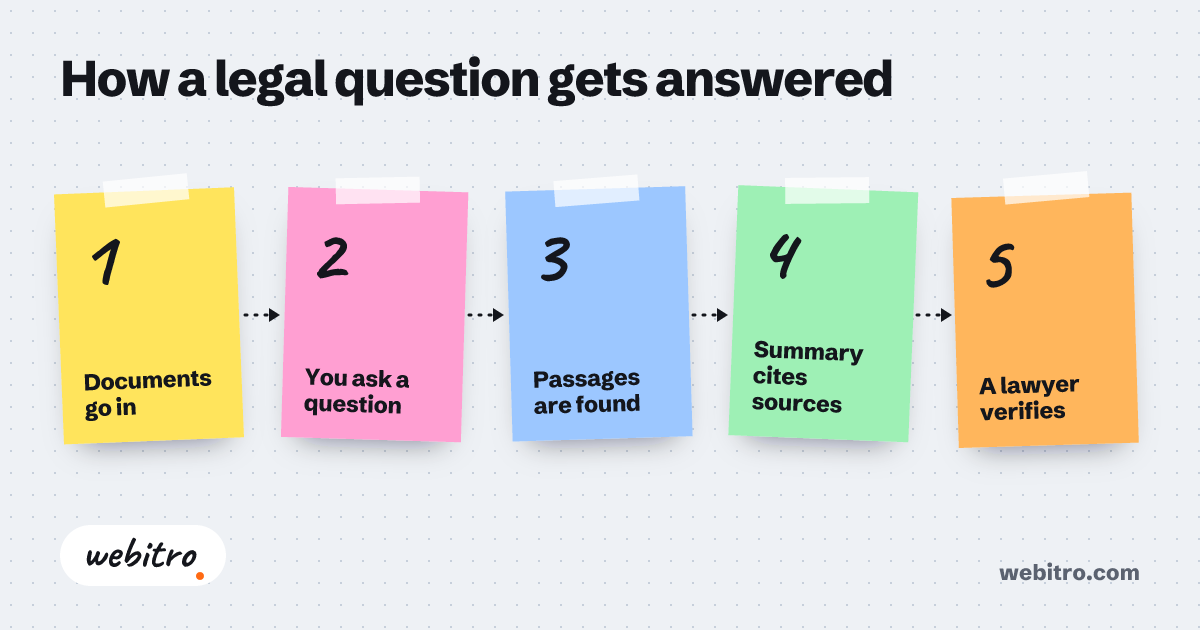
- Legal AI delivers the most value on high-volume, low-ambiguity tasks such as NDA triage, template drafting, and first-pass contract review.
- Custom legal AI usually costs more than a subscription tool upfront and less over time when document volume is high and the workflow is specific to the company.
- The strongest privacy control in a legal AI build is deciding where the model runs and whether prompts and outputs are retained at all.
- A custom legal AI project fails more often from unclear scope than from weak models, which is why one document type and one owner is the safer starting point.
Video summary of this article
Watch this video on its own page
Video transcript
Legal artificial intelligence for startups helps young companies read, draft, and track routine legal documents without replacing their lawyer.
The tool reads incoming contracts and pulls out terms that carry risk. It also drafts routine documents from approved templates and keeps every version in one searchable place.
Start with non disclosure agreement triage, vendor contract review, client intake, and template drafting. Choose tasks that repeat often and whose output is easy to check. Avoid automating everything at once because vague tools get abandoned.
Generic legal tools handle simple summaries and standard templates well. They rarely match your contract positions, intake flow, or existing systems. A custom build can reflect the review logic your company cares about.
Privacy depends on where the model runs, what is stored, and who can open each document. Contracts hold confidential terms, salaries, customer names, and unreleased plans. Written answers about retention and deletion beat confident sales calls.
A licensed attorney still owns negotiation, equity, employment disputes, and court filings. The software prepares the ground but should never give a final answer on a term you will sign.
The full article has all the details.
Our AI for contract review breakdown walks through how these first-pass checks are usually scored and where they still miss.
What Does Legal AI for Startups Actually Do?
Legal AI for startups reads incoming contracts, pulls out the terms that carry risk, drafts routine documents from your templates, and keeps every version in one searchable place.
Picture a small founding team. A vendor sends a long master services agreement on Tuesday, an investor asks for a mutual NDA on Wednesday, and a candidate needs an offer letter by Friday. Nobody has time to read every clause closely, so the first pass gets skipped or rushed.
A legal AI layer does that first pass instead. It flags indemnity language, unusual termination windows, and payment terms that drift from your standard position, then hands the summary to whoever owns the deal.
The second job is drafting. Most startups reuse the same handful of documents, so the tool can fill offer letters, NDAs, and statements of work from approved templates and your own preferred language. Anything outside the template goes to a person.
The third job is memory. When a contract question resurfaces months later — did we agree to auto-renew? — the answer should take seconds instead of an afternoon of email archaeology.
Which Legal Tasks Should a Startup Automate First?
Start with NDA triage, vendor contract review, client intake, and template drafting, because those repeat constantly and their output is easy to check.
Volume is the best filter we know. If your team touches the same document type several times a month, software earns its place in attention alone. NDAs, vendor agreements, and client intake forms all fit that pattern.
Ask another question: can a reviewer tell within a minute whether the output is right? First-pass review and template filling pass that test, because the source document sits right next to the answer. Negotiation strategy, equity splits, and litigation do not.
One more signal — does the task have a clear stopping point? "Check this NDA against our playbook" ends. "Handle our legal work" never does, and tools built around vague mandates get abandoned.
Resist the urge to automate everything at once. A tool that reliably handles one document type gets used daily. A tool that tries to cover every legal task usually loses its users after the first bad summary.
Our AI for contract review breakdown walks through how these first-pass checks are usually scored and where they still miss.
Do Off-the-Shelf Legal AI Tools Cover This?
Generic legal AI tools handle simple summaries and standard templates well, but they rarely match your contract positions, your intake flow, or the systems your team already uses.
Subscription legal tools are a reasonable place to start. They're cheap to try, and a standard NDA or a plain service agreement gets summarized without any setup work on your side.
The friction shows up when your process differs. Maybe your contracts live in a shared drive with a naming convention the tool can't read. Maybe approval has to happen in Slack, or the summary needs to land in your CRM next to the account. Off-the-shelf products decide those details for you.
That's the shape of the custom AI contract review work we take on, from document intake through a review queue your team can actually use.
A custom build also lets you keep the review logic you care about. One company worries about liability caps; another worries about data processing terms. The tool should reflect those priorities instead of a generic checklist nobody reads.
What Drives the Cost of a Custom Legal AI Build?
The main cost drivers are how many document types the tool must read, how many systems it must connect to, how accurate the output has to be, and how much human review stays in the loop.
Scope moves the budget far more than model choice does. Reading one predictable document type is a small job. Reading messy scans in different formats, extracting structured terms, and pushing results into several systems at once is a larger one.
Accuracy requirements matter just as much. A tool that suggests a summary is quick to build. A tool whose output feeds a signed agreement needs confidence scoring, escalation rules, and a way to show why it reached a conclusion.
If you want the general version of that math, our piece on what custom software costs explains how scope turns into hours.
Timelines follow the same logic. A narrow tool that removes one painful step can be in your team's hands fast, while a platform spanning intake to signature needs several rounds of testing before anyone should trust it.
How Do You Keep Contracts and Client Data Private?
Privacy in legal AI comes down to a handful of decisions: where the model runs, what gets stored after each request, who can open which document, and how long anything is kept.
Contracts carry information you can't casually paste into a public chatbot. Confidential terms, salaries, customer names, and unreleased plans all end up inside these files, often in the same paragraph.
When we build, those questions get answered before the first line of code. Do prompts leave your infrastructure? Are logs kept, and for how long? Does the model learn from your documents? Can someone who left the company still reach the archive?
Access control is the part teams underestimate. Most leaks inside a young company come from a shared folder everyone can open, not from a model memorizing a clause.
Ask any vendor a few plain questions: where does inference run, is anything retained, and can it be deleted on request. Written answers beat confident sales calls.
Some teams go further and hand the routine steps to an AI agent development project that drafts, routes, and logs every request.
When Does Legal AI Still Need a Human Lawyer?
A licensed attorney still owns negotiation, equity, employment disputes, and anything filed with a court or a regulator — the software only prepares the ground.
Worth saying plainly: this software is not a law firm and shouldn't pretend to be one. What it does is cut the hours your team spends finding, sorting, and summarizing documents.
What it should never do is give a final answer on a term you're about to sign. The right pattern is a flagged issue plus the clause it came from, handed to a person who can actually decide.
Founders often assume they'll need outside counsel less. In practice they use the same counsel for the questions that matter and stop paying for the ones that don't.
That division of labor also makes the tool easier to defend internally. Your attorney reviews the exceptions instead of the entire inbox, and your team stops treating every vendor email as a crisis.
What Should You Have Ready Before the First Build Sprint?
Bring a set of real contracts, the list of tools the system must connect to, and one person on your team who can judge whether the output is good enough.
Real documents beat written requirements every time. Send the actual NDAs, statements of work, and intake emails you handle, including the ugly scans, and the review logic becomes obvious much faster than any specification would make it.
Then name the systems. Where do documents arrive, where do they get stored, and where does a decision need to appear? Email, cloud storage, e-signature, Slack or Teams, and your CRM are the usual answers.
Finally, pick one person who can say yes or no. A tool with several approvers stalls in review. A tool with a single owner ships.
If you already have a stack of contracts and a bottleneck, talk to us and we'll tell you what's worth building first.
That's the shape of the custom AI contract review work we take on, from document intake through a review queue your team can actually use.
Frequently Asked Questions
Can legal AI replace our lawyer?
No, and it shouldn't try. It handles the searching, sorting, and first-pass reading so your attorney spends time on the calls that actually require a license.
How long does a custom legal AI tool take to build?
It depends on scope, not on team size. A tool that reviews one document type and posts results into Slack moves much faster than a platform covering intake, review, and signature.
Will our contracts be used to train someone else's model?
Not if you control that decision. With a custom build you choose where the model runs and whether prompts or outputs are stored, and you can put those terms in writing.
Do we need a huge archive of past contracts to start?
No. A representative set of the documents you handle most often is enough to define the review logic, and coverage can expand later as new document types show up.
Which integrations should we plan for?
Begin where documents already live and where decisions get made: email, cloud storage, e-signature, Slack or Teams, and your CRM.