Social Media Automation Services: What UK Businesses Should Expect
Social media automation services are builds that link your social accounts to software which schedules posts, answers routine messages and passes genuine enquiries to your team or CRM. Webitro designs these systems for UK businesses that have outgrown manual posting and copy-and-paste inbox work, and we hand them over running rather than as a plan.
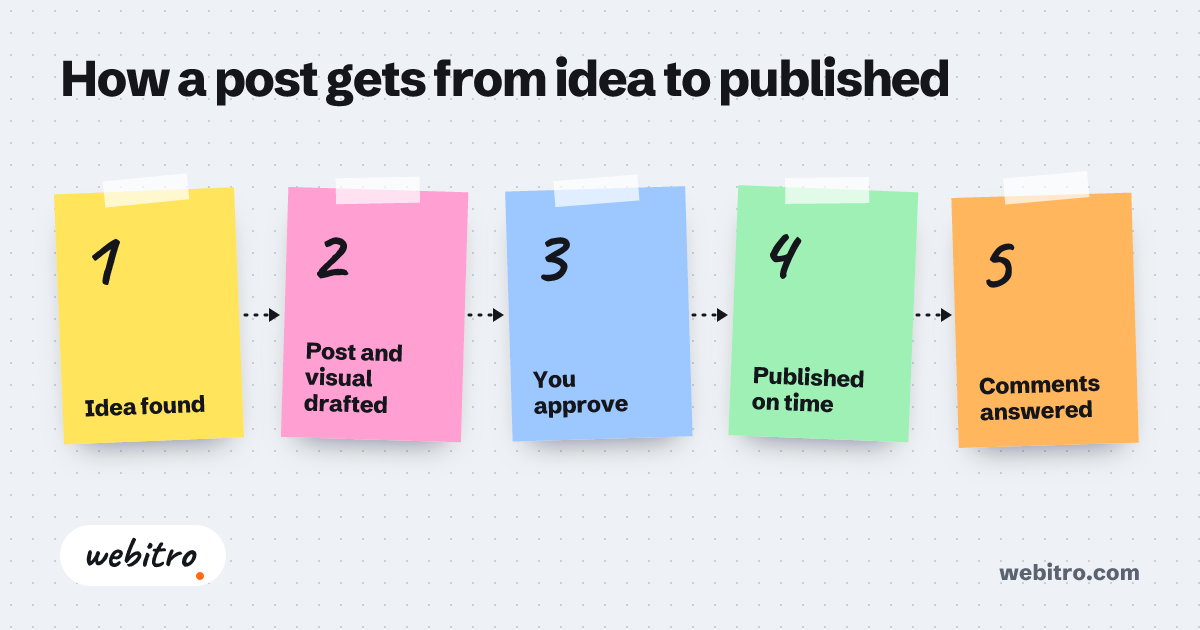
- Public comments are one of the fastest signals of buying intent on social media, and slow replies lose them.
- The cost of a build is driven mainly by platform count, custom logic and integrations rather than by posting volume.
- Platform APIs change regularly, so an automation system needs a named maintenance owner before launch.
Video summary of this article
Watch this video on its own page
Video transcript
Social media automation services link your social accounts to software that schedules posts, answers routine messages and routes real enquiries.
They connect your social channels to software that schedules content and replies to routine messages. The harder half is the inbox, where comments and direct messages arrive and need reading, sorting and routing.
Ready-made tools are the cheaper answer for straightforward scheduling. A custom build earns its place once your routing rules, data and approval steps are specific.
Comments are where opportunities hide, because a question is often a buying signal. Speed counts more than polish, and one article or video can become a fortnight of posts.
A project moves through discovery, a prototype, integration and a documented handover. Handover includes a written runbook, a recorded walkthrough and a named support window.
Three things drive a quote: platform count, logic behind each reply and integrations. Once live, watch first response time, qualified leads and conversations resolved without a person.
The full details are in the written article.
Our breakdown of social media automation tools covers where the mainstream apps stop and where custom work begins.
What social media automation services actually do
They connect your social channels to software that schedules content, replies to routine messages and routes real enquiries to a person or a CRM.
Most teams start with a scheduling tool. That covers the easy half: queueing posts, tidying captions and publishing at sensible times. The harder half is the inbox. Comments, direct messages and form replies land across several platforms, and someone has to read each one, work out what it is and pass it on.
A working system watches every connected channel, sorts each incoming message, answers the ones with obvious answers and escalates the rest with context attached. If a message mentions a budget, a location or a product name, it gets tagged and turned into a task. Your team still decides; they just stop sorting.
Off-the-shelf tools or a custom build?
Ready-made tools are the cheaper answer for straightforward scheduling, while a custom build earns its place once your routing rules, data and approval steps are specific to your business.
Plenty of capable scheduling apps exist, and if your only problem is posting consistently, one of them will do the job. The comparison changes when you need replies in your own tone, leads in your own CRM, or an approval step before anything goes out. Generic tools rarely stretch that far without awkward workarounds. Our breakdown of social media automation tools covers where the mainstream apps stop and where custom work begins.
If you would rather have the workflow shaped around how you already operate, our social media automation services cover scheduling, replies, lead capture and reporting in one place.
Where the work pays off week to week
The clearest gains come from comment triage, first-line replies, lead qualification and turning one piece of content into posts for several channels.
Comments are where opportunities hide. A question under a post is often a buying signal, but it arrives while nobody is watching. A short rule set can reply in public, move the conversation to a private message and log the contact within seconds. Speed counts for more here than polish.
Repurposing is the quieter win. One article or video can become a fortnight of posts, each rewritten for its platform and slotted into the right time of day. The rules you write decide the voice, so the output should still sound like your business rather than a template.
Direct messages deserve their own rules. WhatsApp, Telegram and Discord each behave differently, and our notes on the WhatsApp, Telegram and Discord bot API explain what each channel allows before you commit to a build.
How a build runs from first call to handover
A project moves through discovery, a prototype running on your real accounts, integration with your existing tools, then a documented handover.
We begin by mapping your channels, your inbox and the decisions your team makes each day. From that map we build a small prototype against one live account, so you can hear the tone and see the routing before the full build starts. Nothing gets approved on slides alone. Our walkthrough of taking a product from idea to launch follows the same order we use on client work.
The build then widens to your other platforms and connects to the tools you already pay for. Handover includes a short written runbook, a recorded walkthrough and a named support window, so the system does not end up as something only one person understands.
What actually moves the cost
Three things drive a quote most: how many platforms you connect, how much logic sits behind each reply, and how deeply the system must talk to your existing tools.
Platform count comes first, because every channel has its own rules and quirks. Logic comes second: a keyword reply is simple, while a multi-step qualification flow with approvals is not. Integration comes third, since pushing data into a CRM, booking system or helpdesk adds real work. If you want the underlying factors before you speak to anyone, our piece on what custom software costs walks through the same three variables.
Maintenance needs deciding early too. A retainer, an in-house owner or a mix of both can all work. Ask any supplier to put in writing what happens when a platform changes its API, because they all do, usually without much warning.
What to measure once it is live
Watch first response time, qualified leads per channel and how many conversations are resolved without a person stepping in.
Vanity metrics feel good and change nothing. Response time is the first thing to fix, because a reply within minutes converts far better than one the following morning. After that, track the share of conversations closed without human input and the number of leads reaching your CRM with the right source attached.
Review the rules monthly for the first quarter. Language drifts, offers change, and a reply that sounded right in one season can feel stiff in the next. A short review keeps the system useful instead of letting it fade into background noise.
If you would rather have the workflow shaped around how you already operate, our social media automation services cover scheduling, replies, lead capture and reporting in one place.
Frequently Asked Questions
How long does a build usually take?
It depends on how many channels and integrations are involved. A single-channel prototype can be running quickly, while a multi-platform build wired into your CRM takes longer. You get a stage-by-stage plan before any work starts.
Will the replies sound robotic?
They shouldn't. We draft the tone from your existing posts and messages, and you approve the wording before it goes live. Rules handle the routine, people handle anything sensitive.
Do we have to replace the tools we already use?
Rarely. Most builds sit alongside your current scheduling or analytics software and only take over the inbox and routing work.
What happens if the system gets something wrong in public?
Public replies can be held for approval, and anything outside your decision tree escalates to a person rather than guessing.
Can it work across several brands or locations?
Yes. Each brand or branch can have its own voice, rules and reporting, all managed from one place.