What AI Agent Development Cost Really Depends On
AI agent development cost is the total you pay to design, build, test and run software that plans its own steps and acts on your behalf. It splits into a one-off build and a monthly running bill, and how those two are balanced is where most quotes quietly go wrong.
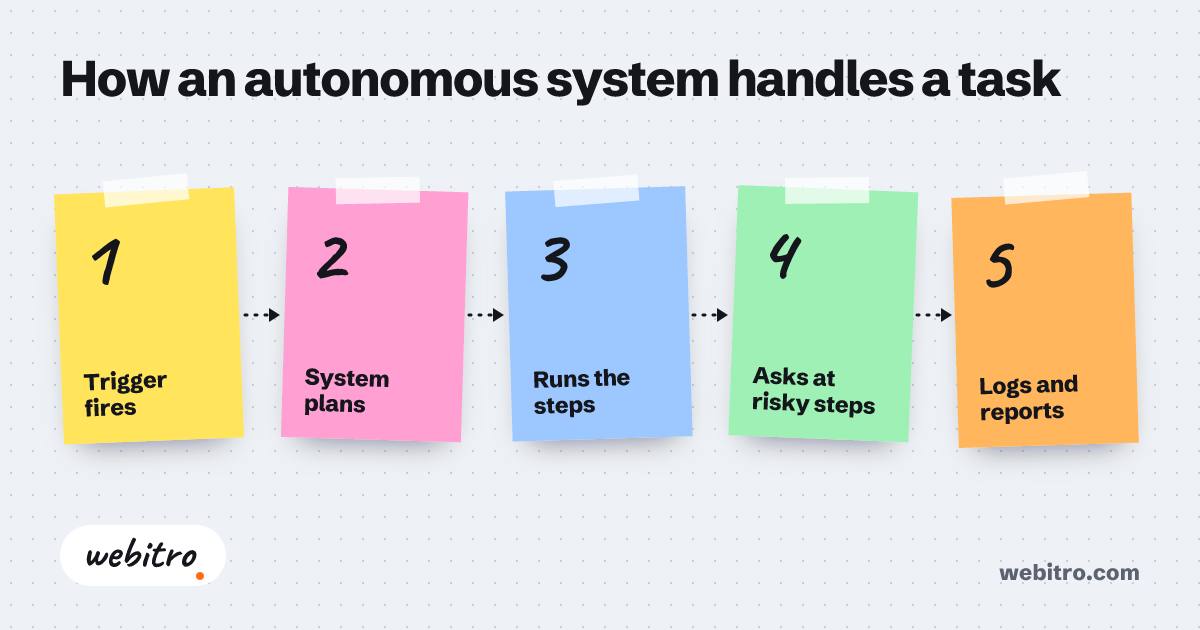
- Most of an AI agent's build cost sits in integration, testing and data preparation rather than in the language model itself.
- Running costs recur monthly and continue for as long as the agent is live, so they belong in a separate budget from the build.
- A custom agent usually costs more up front than a subscription tool, but it can replace recurring manual work and licence fees.
If you are still asking what AI agents are, the plain answer is software that decides its next step and then takes it.
What is actually included in an AI agent build?
An AI agent build covers discovery, design, integrations, testing and the environment the agent runs in, plus everything needed to keep it working afterwards.
An AI agent is software that plans its own steps, calls other tools and completes a task without a person clicking through every screen. Building one covers discovery, design, integration, testing and the environment the agent lives in.
If you are still asking what AI agents are, the plain answer is software that decides its next step and then takes it. That definition matters, because autonomy is what you are paying for, and it is also what makes testing harder.
Cost splits into two piles. The build is one-off and ends when the agent goes live. The running bill — model usage, hosting, monitoring — carries on for as long as the agent stays switched on, and it is the part most budgets underestimate.
Integrations usually drive the early estimate. Every system the agent touches, from your CRM to your email provider, needs a connection, plus error handling for the days those systems misbehave.
Evaluation and guardrails are easy to overlook. Someone has to write test cases, check the agent's answers and set limits so it cannot send the wrong message or approve an order it should have questioned.
Ask any supplier to separate those two piles in writing. A single blended figure hides which part of the project is expensive, and that is exactly the part worth negotiating.
Which factors push an AI agent quote up or down?
Scope, the number and messiness of integrations, the state of your data and how much human oversight you want decide most of the final figure.
Narrow, repetitive jobs cost less than open-ended ones. An agent that answers a fixed set of support questions is far simpler to build than one that negotiates timelines with suppliers and chases invoices.
Integration count matters more than model choice. Joining one clean API is straightforward. Wiring together several systems that share no common identifiers turns into weeks of mapping and reconciliation.
Data quality decides how much preparation you pay for. If your records live in spreadsheets where the same client name is spelled differently each time, that has to be tidied before the agent can be trusted with anything important.
Timelines follow the same logic. Every extra system and every approval step adds build days, and build days are what you are really buying when you commission bespoke software.
Oversight adds work as well. Approval screens, audit logs and a clean handover to a person all need designing, and each one pushes the build further out.
Is a custom AI agent cheaper than off-the-shelf software?
Subscription tools cost less up front, while a custom agent often wins once you count the manual work it removes and the licence fees you stop paying.
Off-the-shelf products are quick to trial. The catch arrives when your process does not match the template and you end up paying staff to bridge the gap by hand, every single week.
It helps to compare this with custom software cost more broadly, because agents pass through the same discovery, build and testing stages as any bespoke system. The difference is that an agent also keeps making decisions after launch.
Most teams begin with AI automation of a single task, then commission a full agent once the first results are in and the numbers look sensible.
Custom builds carry a higher upfront figure. In return you own the workflow, and the agent fits how your team already works rather than the other way round.
Volume decides the winner. Where a task happens occasionally, a subscription is the sensible call. When the same job fills someone's week, the calculation moves firmly the other way.
What are the running costs after launch?
Running costs recur every month and cover model usage, hosting, storage, monitoring and small changes as your business moves.
Model usage is metered by the provider. Longer conversations, larger documents and heavier reasoning all consume more, so an agent that gets used more costs more each month.
Hosting depends on where the agent sits. Choosing between a local server or cloud sets the shape of that bill, with one scaling with demand and the other trading flexibility for predictability.
Monitoring is not a nice-to-have. Someone has to watch failure rates, read the logs and repair connections when a third-party API changes without warning.
Leave room for change. Business rules shift, teams reorganise and suppliers update their terms, so a modest maintenance allowance keeps the agent useful instead of quietly broken.
Treat this as a standing cost, not a project cost. It arrives whether or not you have anything new to build that month.
How do you keep an AI agent project on budget?
Fix the scope, ship a small first version and judge the results before you pay for the next capability.
Start with one workflow that hurts. A single, well-defined task gives you a real benchmark for every quote that follows, and a way to tell whether the agent is earning its keep.
Ask for a staged build. The first stage proves the idea; later stages add integrations and autonomy once you can see it working in your own systems.
Request an itemised quote. A breakdown across discovery, integration, testing and support shows where the money goes and where you can trim without gutting the project.
Name an owner on your side. Decisions stall when nobody internally carries the agent, and a stalled build burns budget while delivering nothing at all.
That is the approach behind AI agent development at Webitro: a staged plan that sets out scope, cost and what the agent will do before any code is written. If you would rather talk it through, talk to us and we will walk your workflow line by line.
Most teams begin with AI automation of a single task, then commission a full agent once the first results are in and the numbers look sensible.
Frequently Asked Questions
How long does it take to build an AI agent?
A focused first version is usually measured in weeks, not days. Integrations and testing stretch that, especially when the agent has to touch systems that were never designed to talk to each other.
Can I get a fixed price for an AI agent?
Yes, once the scope is frozen and the integrations are known. Before that, any fixed number is a guess dressed up as a commitment.
Do I pay for the model separately?
Usually, yes. Model usage is metered by the provider, so it lands in your monthly running costs rather than in the build fee.
What is the biggest hidden cost?
Data cleanup and ongoing monitoring. Neither shows up in a polished demo, and both quietly take real time to get right.
Is a cheaper agent worth building at all?
Only if it still solves the task you care about. A narrow agent that handles one painful job well usually beats a broad one that half-works.