B2B Lead Generation Services: What You're Actually Buying
B2B lead generation services are the systems and teams that find the right companies, verify the right buying contacts, start conversations, and pass qualified meetings to your sales team. Some vendors sell lists. Others run cold email campaigns and stop there. We build the whole chain and hand it over working — so before you sign anything, ask what exactly you're buying and who owns it after launch.
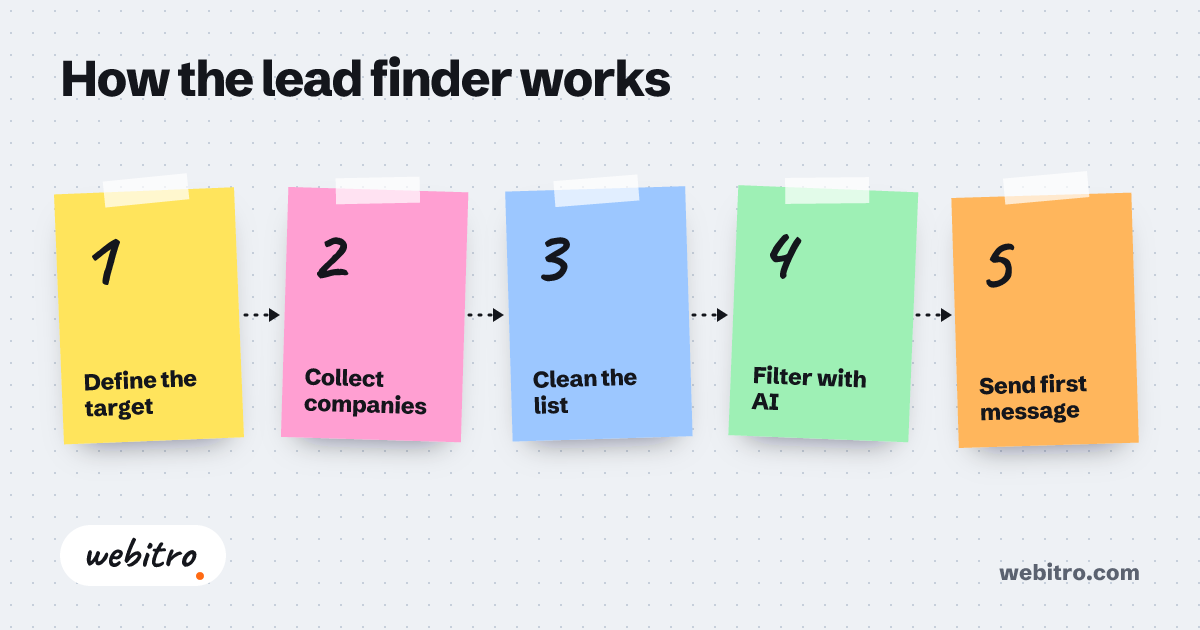
- A lead generation system has three parts — sourcing, qualification, and outreach — and the weakest part sets your ceiling.
- Reply rates respond more to targeting accuracy than to sending volume.
- Ongoing list maintenance, not initial list size, is the cost that grows over time.
- New sending domains need a gradual ramp before they can safely carry full volume.
Video summary of this article
Watch this video on its own page
Video transcript
Business to business lead generation services build a system that finds companies, verifies contacts, starts talks, and gives qualified meetings to sales.
Services find fitting companies, verify buying roles, start conversations, and hand qualified buyers to sales. The weakest part sets your ceiling, so fix sourcing and qualification first.
Artificial intelligence is fastest at sourcing accounts, enriching records, and drafting first messages. It is weakest at judgment calls about fit, so people decide pursuit and truth.
Subscription tools move you fastest when your sales motion is standard. A custom build wins when your data, pricing, or buying process does not fit a template.
Quotes move with the number of data sources and depth of custom logic. List maintenance, not initial list size, is the cost that grows over time.
Watch reply rate, qualified meetings booked, and cost per qualified meeting. Review monthly because sequences decay, titles shift, and sources go quiet. A lead generation system is a process you maintain, not a campaign you finish.
Details are in the article.
If you want to compare platforms before committing, our breakdown of the best lead generation software explains what each tool is genuinely good at.
What B2B Lead Generation Services Actually Do
B2B lead generation services build and run the system that finds fitting companies, verifies contact details, starts conversations, and hands qualified buyers to your sales team.
These services sit between "we need more pipeline" and "a qualified buyer is on your calendar." Most providers pick one slice: list building, cold email, LinkedIn outreach, appointment setting, or paid demand capture. We build the whole chain, because a broken handoff is where most programs quietly stall.
A working setup has three moving parts. Sourcing decides which companies match your ideal customer profile. Qualification checks that a contact holds a buying role and that the account shows real intent. Outreach starts the conversation and keeps it going until someone answers, objects, or opts out.
Order matters more than tooling. Loose qualification means ignored emails and a bruised sending reputation. Overly broad sourcing means your reps spend the week on calls that never had a chance. Fix those two before you rewrite a single email.
Where AI Fits in Lead Generation
AI is fastest at the repetitive parts of outreach — sourcing accounts, enriching records, drafting first-touch messages — and weakest at judgment calls about fit.
The boring work is where AI pays off first. Crawling company sites, matching job titles to buying roles, checking whether a domain is still active, and collapsing three overlapping lists into one — that is manual labor a script finishes in minutes.
Personalization is the next layer. Give a model the prospect's industry, a recent trigger event, and your actual value proposition, and it can open with something real. Give it only a name and a company, and you get the same email everyone else sends.
Keep a human on the final check. Someone still has to decide whether an account deserves pursuit and whether the message is true. That's the core of what our AI lead generation services cover, from sourcing through handoff.
Off-the-Shelf Tools or a Custom Build
Subscription tools get you moving fastest when your sales motion is standard, while a custom build wins when your data, pricing, or buying process does not fit a template.
If your process looks like everyone else's — same channels, same CRM, same qualification rules — a subscription tool will move you forward in days. The trade-off is that someone else's workflow shapes your process, not the reverse.
Custom builds make sense when leads arrive from places that don't plug in cleanly: a niche marketplace, a partner portal, a spreadsheet your operations team has guarded for years. When those sources live behind public pages, our web scraping services turn them into one clean, deduplicated list your team can actually work.
If you want to compare platforms before committing, our breakdown of the best lead generation software explains what each tool is genuinely good at.
What Drives the Cost
Cost tracks scope — how many data sources feed the system, how far your qualification rules sit from a template, and who maintains the setup after launch.
Quotes move with three things: the number of data sources, the depth of custom logic, and ownership after launch. Ask any vendor to split the proposal into data, build, and ongoing management so you can compare offers on equal footing.
List size matters less than people assume. Pulling a bigger file costs a little more. Keeping that file accurate, current, and free of duplicates is the part that keeps costing money month after month.
A low build fee paired with heavy management charges is a different deal than it looks on page one. For a closer read on how scope becomes a quote, see our guide to custom software cost.
How Long a Build Takes
A focused single-channel system launches in weeks, while a multi-source setup with enrichment, scoring, and CRM sync takes longer because integrations and data clean-up are unpredictable.
Domain warm-up is the calendar item teams forget. A new sending domain needs a gradual ramp before it carries real volume, and skipping that step risks the whole email program, not just one campaign.
Integrations are the other variable. Connecting a CRM is routine. Connecting a homegrown database that two people understand is a project of its own, and it deserves its own line on the timeline.
We scope against a launch date and work backward from it, the same way we describe in our walkthrough from idea to launch.
How to Tell It Is Working
Watch reply rate, qualified meetings booked, and cost per qualified meeting — volume numbers feel good and tell you almost nothing on their own.
Reply rate shows whether targeting and message match. Qualified meetings show whether sales agrees with your definition of fit. Cost per meeting tells you whether the whole system is worth scaling or rebuilding.
Review it monthly. Sequences decay, job titles shift, and a source that performed last quarter can go quiet without warning. A lead generation system is a process you maintain, not a campaign you finish.
If you already automate back-office work and wonder how this differs from older scripting, the answer sits in our piece on AI automation vs RPA.
That's the core of what our AI lead generation services cover, from sourcing through handoff.
Frequently Asked Questions
How much do B2B lead generation services cost?
It depends on scope, not a rate card. A single-channel outreach build costs far less than a multi-source system with enrichment, scoring, and CRM sync. Ask for the quote split into data, build, and management so you can compare vendors honestly.
How soon do meetings start landing on the calendar?
Expect the first replies a few weeks after launch, once domains are warmed and targeting is dialed in. Rushed launches that skip warm-up usually cost more time than they save.
Can AI-written outreach avoid sounding like a robot?
Yes, if you feed it real context: the prospect's role, a trigger event, and a specific reason you're reaching out. Generic prompts produce generic email, and buyers delete generic email.
Do we still need salespeople if we automate this?
Yes. Lead generation books conversations; it doesn't close them. Clean notes, context, and timing at the handoff are what keep a qualified meeting from turning into a cold call.
Who owns the system and the data afterward?
You should. Ask that question before signing, and get the answer in writing — including what happens to your lists, sequences, and integrations if you ever move on.