Custom AI Agent Development: Building Agents That Do the Work, Not Just Chat
Custom AI agent development is the discipline of building a goal-driven AI system around your own data, tools and permissions instead of reshaping a ready-made assistant to fit. This guide walks through what such an agent is made of, how a build runs from the first workshop to launch, what moves the cost, and where the returns show up first.
- Custom agents only outperform off-the-shelf tools when the work depends on private data, internal permissions or multi-step decisions.
- Most engineering effort in a production agent goes into orchestration, integrations and guardrails rather than into the model itself.
- An agent without an evaluation set cannot be improved reliably, because nobody can tell whether a change helped or hurt.
- The clearest first use case is usually high-volume, rule-heavy work that currently involves copying data between systems.
If you want the plain-language version first, our explainer on what AI agents actually are is a good place to start.
What Is Custom AI Agent Development?
Custom AI agent development is the work of building a goal-driven AI system around your own data, tools and rules instead of reshaping a ready-made assistant to fit them.
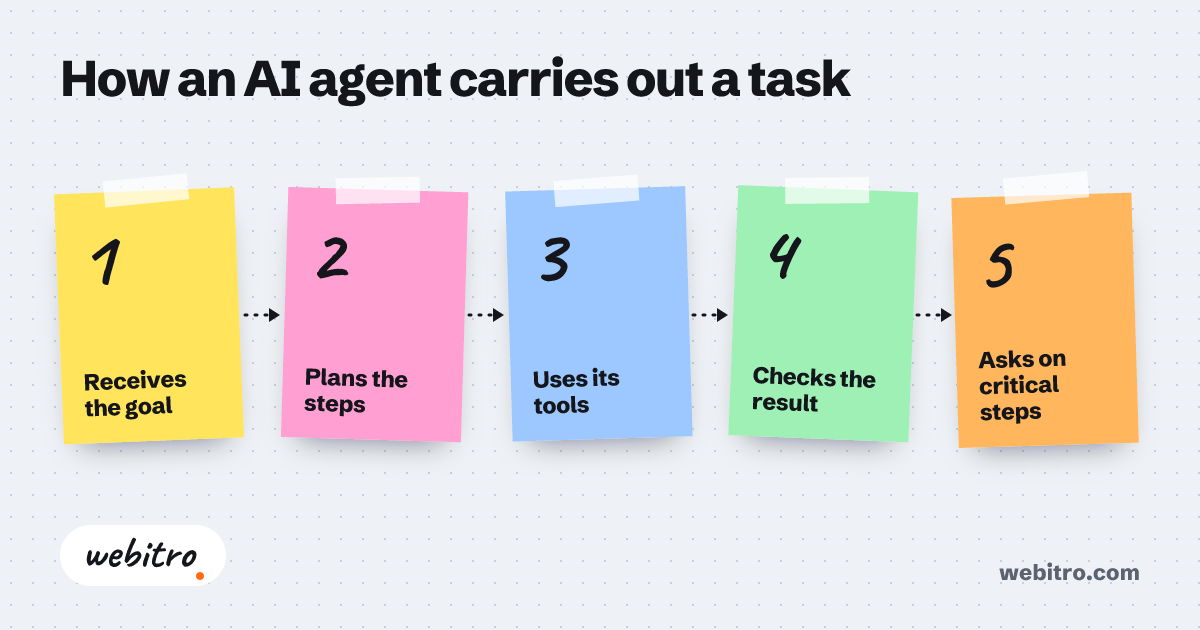
Most people picture a chatbot when they hear "AI agent." That picture is too small. An agent takes a goal, decides which steps to take, calls the tools it needs and checks its own work before it hands anything back.
Custom development starts from the goal, not the model. We look at what the job really needs: which systems hold the data, who signs off on the output, and where a wrong answer would cost you money or trust.
That is why two companies can run the same underlying language model and get completely different results. One agent knows the pricing rules, order history and escalation paths. The other one guesses. If you want the plain-language version first, our explainer on what AI agents actually are is a good place to start.
Custom Agents vs. Off-the-Shelf AI Tools
Ready-made AI tools are the faster, cheaper choice for generic writing and summarising, while custom agents earn their cost when the work depends on your own data, permissions and decision rules.
Be honest about the trade-off. A subscription tool can draft a reply or summarise a document this afternoon, and for plenty of one-off tasks that is genuinely enough. Nobody should commission an agent for something a browser tab already solves.
The picture changes the moment the task becomes a chain. Reading an enquiry, checking stock, pricing it, writing the quote and logging it in your CRM is not a single prompt. It is a sequence with decisions, and each decision needs your rules rather than a general assumption about how businesses work.
Permissions are the other dividing line. A generic assistant has no idea which customer records a sales rep may see. A custom agent inherits your access model, so it can act inside it without someone manually checking every step afterwards.
What a Production Agent Is Actually Made Of
A production agent combines a reasoning model, a set of tools it can call, memory for context and guardrails that bound what it is allowed to do.
Start with the model, but do not stop there. The model reasons; it does not act. To change anything in the real world it needs tools: your API, your database, a scraper, a calendar, a payment provider.
Memory is what keeps a workflow coherent. Short-term memory holds the task at hand. Long-term memory, usually a vector store, holds the facts and documents the agent should recall the next time a similar request arrives.
Around all of it sit guardrails and evaluation. Allowed actions, spending limits, mandatory human approval on risky steps and a test set you run before every release. The coordination layer is often called AI orchestration, and it is where most of the engineering effort lands.
How a Custom Agent Build Runs, Step by Step
A custom agent build moves through discovery, a deliberately narrow prototype, integration, evaluation and launch, with something you can test long before final delivery.
We begin with a discovery session, not a proposal. The aim is to pick one workflow, define what "done" looks like and agree on how we will know the agent is right. Vague scope is the single most common reason agent projects stall.
Next comes a working prototype on your real data — narrow, rough in places, but functional. You talk to it. You try to break it. Feedback at this stage is cheap; feedback after integration is not.
Then we connect it to the systems that matter, run it against real cases and only afterwards put it in front of customers. Our AI agent development service follows exactly this path, from the first workshop to a running system you own.
What Drives Cost and Timeline
Cost and timeline depend mainly on how many systems the agent must touch, how clean your data is and how much human review the workflow requires.
There is no honest flat rate for this work, and anyone quoting one before discovery is guessing. The variables are knowable, though, and we price against them openly instead of padding a number.
Integration count is the heavy one. An agent that reads from one well-documented API is a different job from one that reconciles four legacy systems with inconsistent customer IDs. Data quality sits right beside it, because messy records turn into wrong actions.
Human review is the third lever. Every checkpoint you add makes the agent safer and slower. For the wider picture, our notes on what drives custom software cost explain how scope, integrations and data quality move the budget.
Where Custom Agents Pay Off First
The quickest returns usually come from high-volume, rule-heavy work where someone currently copies information between systems by hand.
Look for repetition with rules attached. Qualifying inbound leads against your ideal-customer profile is a job an agent can do continuously, at any hour, without forgetting to follow up — see our work on AI lead generation.
Support is the other obvious entry point. AI chatbots that answer from your documentation, escalate what they cannot handle and remember the ticket history take real pressure off a small team.
Less obvious but often more valuable: pulling structured data off supplier portals with web scraping, running multi-step research, or building an analysis system that watches markets and flags movements without pretending to give investment advice.
If you already know which workflow keeps eating your team's week, get in touch and we will say honestly whether it needs an agent or a simpler fix.
Mistakes That Sink Agent Projects
Most agent projects fail for the same reason: the team automated a process nobody had defined, then judged the result on instinct.
Automating a vague process only makes the confusion faster. If two people on your team would handle the same request differently, the agent has no chance of being consistently right.
The second trap is having no evaluation set. Without a fixed batch of real cases and expected outcomes, nobody can tell whether a prompt change helped or hurt. Ship on gut feeling and you will ship regressions you never notice.
Third: no fallback. Agents fail. A good build knows what happens when a tool times out or the model is unsure, and hands the task to a human cleanly rather than inventing an answer that sounds confident.
After Launch: Keeping the Agent Sharp
Launch is the midpoint rather than the finish, because agents need monitoring, periodic re-evaluation and retuning as your data, tools and rules drift.
Models get updated, APIs change shape, your pricing moves and customer language shifts. An agent that was accurate in month one can quietly degrade by month six without anyone noticing until a customer complains.
So we log decisions, track where humans override the agent and review those cases on a schedule. Those overrides are the most useful improvement signal you will ever get, and they cost you nothing to collect.
If you would rather see how a project like this is staged before committing, our guide takes you from idea to launch step by step.
Our AI agent development service follows exactly this path, from the first workshop to a running system you own.
Frequently Asked Questions
How long does custom AI agent development take?
It depends on scope, but most builds produce a testable prototype well before final delivery, then spend the remaining time on integration and evaluation. A narrow first release always ships faster than an agent expected to handle everything at once.
Do we need our own data to build a custom agent?
It helps enormously, but you do not need a data warehouse. Documentation, old tickets, product catalogues and CRM records are usually enough to start. If nothing is written down, part of the project becomes capturing that knowledge first.
Can an agent work with the tools we already use?
Yes, as long as those tools expose an API or a reachable database. We connect to CRMs, helpdesks, spreadsheets, internal admin panels and public websites. Where no integration exists, browser automation or scraping fills the gap.
Will a custom agent replace our team?
No. It takes the repetitive middle of the work and leaves judgement, exceptions and relationships to people. The teams getting the most out of agents are usually the ones that reassign the saved hours rather than cutting headcount.
How do we know the agent is giving correct answers?
With a fixed test set of real cases and expected outcomes, run before every change. On top of that we log live decisions, flag low-confidence ones and review the cases where a person overrode the agent.