Personalised Games: How Custom Games Adapt to Every Player
Personalised games are playable experiences that reshape themselves around the person playing — their name, their choices, their data, their skill level — instead of serving everybody the same fixed story. You will also see the American spelling, personalized games, and it means exactly the same thing. In the UK, most brands commission them for marketing campaigns, staff training or loyalty work.
- Personalisation in games usually comes from three sources: stored profile data, live player behaviour, and content generated at runtime.
- Template campaign platforms cap personalisation at name swaps and scores, so deeper adaptation normally requires custom development.
- Any personalised game handling UK player data falls under UK GDPR, which makes consent and retention design decisions rather than afterthoughts.
Video summary of this article
Watch this video on its own page
Video transcript
Personalised games reshape themselves around each player instead of serving everyone the same fixed story.
A personalised game changes based on data about the player. That data may be a typed name or a customer record. Personalisation covers content, difficulty and framing.
Personalisation is driven by stored profile data, live behaviour and runtime content. The game reads these feeds to decide what happens next. Live behaviour includes timing, mistakes and replays.
Templates work when personalisation needs only a name and score. Templates go live in days, but their limits are fixed. Custom builds win when the game must connect to your systems or adapt to play.
Cost is set by personalisation depth, art, audio, platforms and integrations. Timelines stretch with scope, from one platform to deep integrations. Discovery, prototype, production, testing and launch follow.
Artificial intelligence supplies endless variants, adaptive difficulty and conversational characters. Games collecting United Kingdom data fall under United Kingdom data protection rules, so consent and retention must be designed in. Judge success by completion rate and business action, not opens.
The full details are in the article.
If you want the plumbing behind that, our notes on custom AI agent development cover how models, tools and memory fit together.
What exactly counts as a personalised game?
A personalised game is any game that changes what the player sees or does based on data about that specific player, whether that is a name typed at the start or a profile pulled from your CRM.
Strip away the jargon and personalisation is really three things: content, difficulty and framing. Content is a character named after the player, a quiz that lands on their industry, a level built from their answers. Difficulty is the game getting easier or harder as they play. Framing is the wrapper — the logo, the colours, the copy that makes it feel like theirs.
Common examples you have probably played: a football club's web game where you manage your own starting eleven, a recruitment quiz that builds a career path from your answers, a Christmas campaign where the player's pet appears in the animation, a training simulation that throws harder scenarios at people who answer quickly.
The bar has moved. A few years ago a name swap was enough. Now players expect the whole experience to react, and AI has made that affordable for smaller budgets.
How does personalisation work under the bonnet?
Personalisation is driven by three feeds — stored profile data, live player behaviour and content generated at runtime — which the game logic reads to decide what happens next.
Most builds pull from a profile. That might be a login from your site, a CRM record, a set of answers from a form, or a link with the player's name in the query string. The game reads it once at the start and sets the session up.
Live behaviour is the second feed. Timing, mistakes, replays and drop-off points all tell the game what the player needs next. Someone who fails the same jump three times probably wants a shorter gap, not a harder one.
Generated content is the newest feed. Instead of writing forty variants of a scenario by hand, you produce them on the fly. If you want the plumbing behind that, our notes on custom AI agent development cover how models, tools and memory fit together.
Template or custom build: which makes sense?
Templates are the right call when personalisation only needs a name and a score, while a custom build wins once the game has to connect to your systems, match your brand or adapt to how people play.
Template tools and white-label campaign platforms get you live in days. The trade-off is that the mechanics, the art style and the limits of the personalisation are fixed. If your idea sits comfortably inside those limits, take the template and spend the budget on promotion.
Custom work starts to make sense in a few situations. You need data flowing in from your own systems. You want the game to keep earning after the campaign ends. You need it in an app, on a kiosk, or inside a learning platform. Or you simply want something competitors cannot copy in a week.
What drives the cost of a personalised game?
Cost is set by personalisation depth, bespoke art and audio, the number of platforms, and how many external systems the game has to talk to.
Personalisation depth is the biggest lever. Swapping a name is cheap. Adapting levels, generating unique scenarios or building a player profile that persists across sessions takes real engineering, because every rule has to be designed, tested and made to fail gracefully.
Art and audio come next. Bespoke characters, animation and sound design usually cost more than the code. Reusable assets, a flat illustration style or a single character rig bring the figure down sharply without looking cheap.
Integrations are the quiet cost. Single sign-on, CRM sync, leaderboards, payments, analytics and admin dashboards each need building and testing. For a fuller picture of how those line items stack up, our breakdown of custom software cost is worth a read.
How long does a personalised game take to build?
Timelines stretch with scope — a single-platform browser game with light personalisation moves fastest, while deep data integration, bespoke art and multiple devices add whole stages.
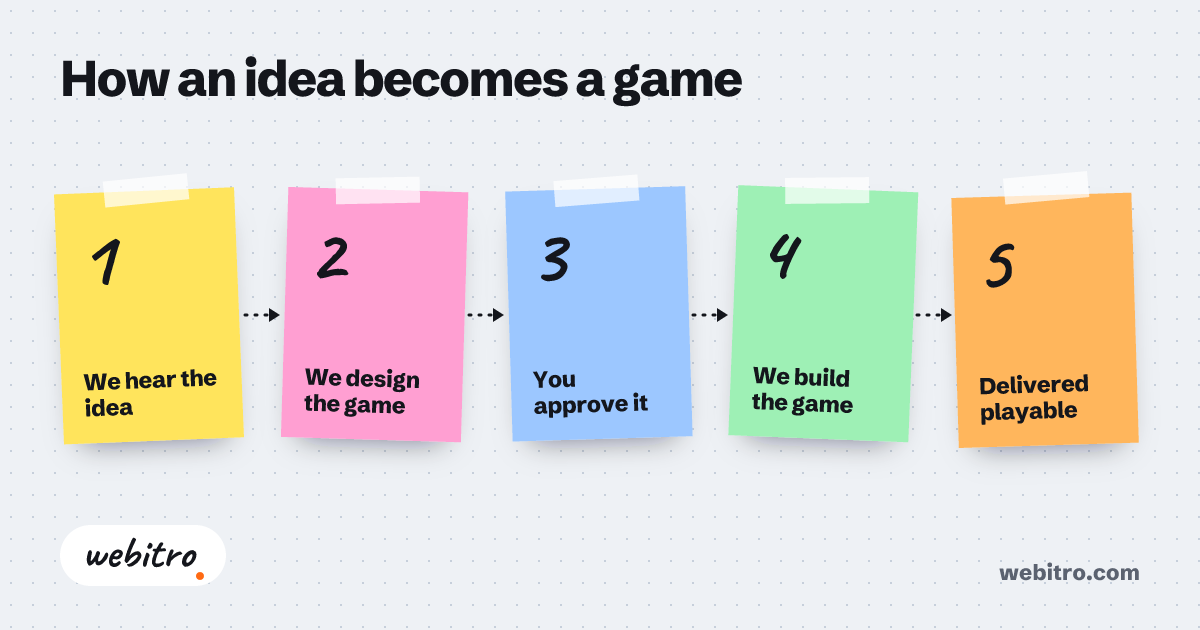
Discovery comes first: what the game has to do, who plays it, what a win looks like. Skipping this stage is the most expensive shortcut we see, because design decisions made later cost far more to unpick than to get right at the start.
Then a playable prototype. Thin, ugly, but real enough to test the personalisation rules with actual people. If the idea is boring at this stage, no amount of artwork will save it.
Production, testing and launch follow. Art, sound, integration, QA on real devices, then a soft launch with a small group before the campaign goes wide.
Where does AI fit into personalised games?
AI supplies the variation that used to be hand-written: endless text, art and level variants, difficulty that adjusts in real time, and characters that respond to the player in their own words.
Adaptive difficulty is the least flashy and most useful. The game watches how someone plays and quietly adjusts the challenge, so a first-timer and a regular both stay in the sweet spot rather than one of them getting bored or stuck.
Generative content goes further. A scenario, a rival's dialogue or a puzzle layout can be created for one player and never repeated. For brands running long campaigns, that removes the ceiling on how much content exists.
Conversational characters are the third use. Voice or text input lets a player talk to a character inside the game, which suits training simulations and story-led campaigns. That is where our browser game development work usually starts — with a small, testable mechanic rather than a full world.
What about data, consent and UK rules?
Any personalised game that collects names or behaviour falls under UK GDPR, so consent, retention and a readable privacy notice have to be designed in from the start rather than added afterwards.
Personalisation runs on data, so the two travel together. Ask only for what the game genuinely uses, say plainly what happens to it, and give people a way to play without handing anything over at all.
Games aimed at children deserve extra care. Age gates, minimal data collection and a chat filter are the baseline if under-thirteens might play. The ICO's children's code is the reference most UK teams work from.
How do you know the game worked?
Judge it on completion rate, repeat plays and the business action you wanted — a sign-up, a share, a purchase — not on how many people opened it.
Opens are vanity. A campaign with a hundred thousand starts and nobody finishing tells you the personalisation was noise. Completion rate shows whether the experience actually held attention.
Repeat plays and shares show genuine pull. Tie those to a business measure: leads captured, staff finishing training, basket value on the follow-up purchase. Set the target before launch, or you will end up arguing about the numbers afterwards.
For a look at how a build comes together stage by stage, the browser game development guide covers concept, prototype and launch in more detail.
That is where our browser game development work usually starts — with a small, testable mechanic rather than a full world.
Frequently Asked Questions
What is a personalised game in simple terms?
It's a game that changes for each player. Their name, their answers or their past behaviour feed into what they see, so two people playing the same game get noticeably different experiences.
How much does a personalised game cost?
It comes down to scope. Personalisation depth, bespoke art, integrations and the number of platforms move the figure most. We price each build individually after a short conversation about what you actually need.
Can you add personalisation to a game we already run?
Often, yes. If the existing game exposes player data or a clean API, we can layer personalisation on top. If it's a locked third-party product, rebuilding the mechanic is usually quicker than fighting it.
Do personalised games work for B2B, or only consumer campaigns?
They're strong in B2B. Recruitment quizzes, product configurators and training simulations all benefit, because the player's own context makes the scenario feel relevant instead of generic.
How soon can we test something real?
We usually aim to get a rough playable prototype in front of real players long before the finished build, so the personalisation rules can be judged on evidence rather than opinion.