AI Agents Accessing Financial Accounts: What Actually Gets Built
AI agents that access financial accounts are programs given a scoped, permissioned connection to a bank, brokerage, card, or payment account so they can read balances and transactions or carry out a narrow approved action without a person copying data by hand. The interesting part is never the model. It is the permission boundary around it.
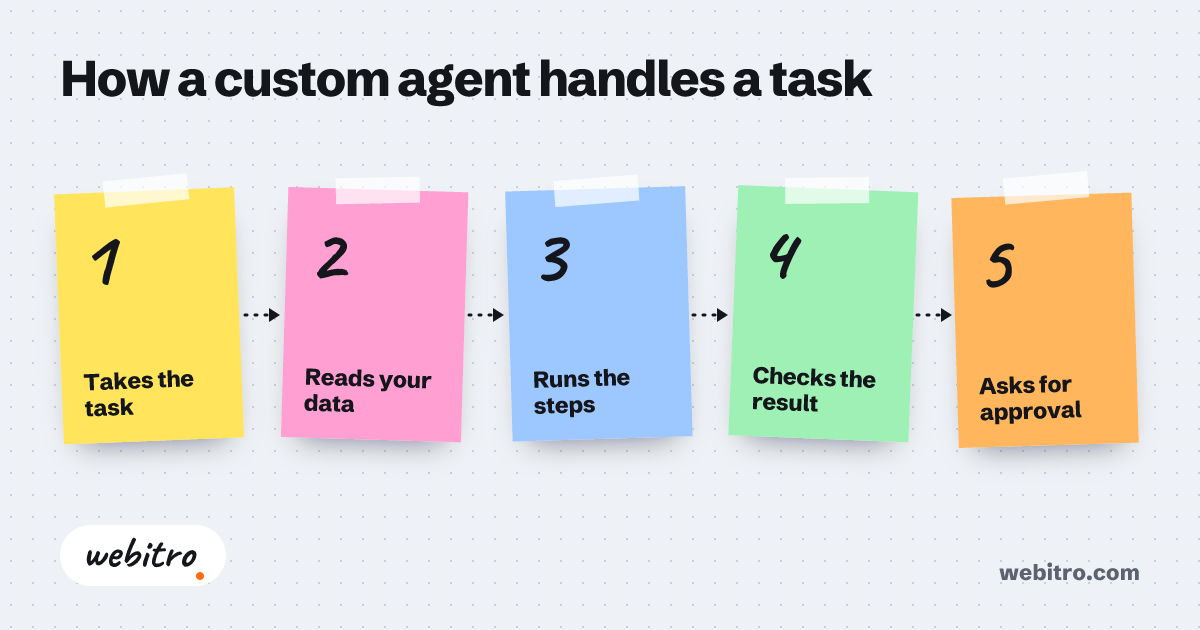
- Read-only access through a bank API or aggregator covers most monitoring use cases, which keeps payment authority out of a first release.
- Screen-scraping stored bank credentials fails whenever an institution changes its sign-in flow, so it works as a bridge but not as a foundation.
- Spend and transfer ceilings must be stored outside the model, because a prompt cannot enforce a limit on its own.
Video summary of this article
Watch this video on its own page
Video transcript
This article explains how artificial intelligence agents connect to financial accounts and what controls shape a safe build.
An agent holds a limited, revocable grant to specific accounts. It can only do what that grant allows, not whatever the model chooses. The permission boundary around the model is the important part.
Direct bank connections use token-based consent and are the most stable route. Aggregators maintain connections to many institutions and absorb bank sign-in changes. Screen scraping works as a bridge but breaks when sign-in flows change.
Start read-only because balances and transactions deliver most value with far less risk. Payment authority needs retries guarded so a call cannot pay twice. A suggestion queue lets the agent prepare actions for human approval.
Every deployment needs explicit, revocable consent and least-privilege tokens stored in a vault. An immutable audit log should record every read and every write. Hard ceilings must sit outside the model so prompts cannot override limits.
Subscription tools fit common workflows, while custom builds fit internal systems and approval rules. Ask vendors how consent is revoked and where tokens are stored.
More details are in the full article.
Before choosing between them, it helps to see how AI agents work, because the connection route decides what the agent can safely do.
What Does It Mean When an AI Agent Accesses a Financial Account?
It means the agent holds a limited, revocable grant to specific accounts — usually read-only at first — and can only do what that grant allows, not whatever the model feels like doing.
The phrase covers a wide spread of setups, and that spread matters when you scope a build. At one end sits a monitoring agent that reads balances and flags a checking account running low. At the other sits an agent that moves money, pays invoices, or places trades.
Nearly everything a business actually wants lands in the middle. Think reconciliation agents that match incoming payments to invoices, cash-flow assistants that warn about a payroll shortfall, or bookkeeping agents that categorize transactions before your accountant opens the file.
None of those need the ability to move funds. They need reliable read access, a clean data model, and a human who signs off on anything that leaves the system. Getting that line right early saves a rebuild later.
How Do AI Agents Connect to Banks and Brokerages?
Most production systems use a bank's own API or a data aggregator with token-based consent, and scraping a consumer login page is the fallback because it breaks whenever the institution changes its flow.
Three routes exist, and they differ mainly in how often they fail. The most stable is a direct API from the institution, using an OAuth-style flow so the customer grants a token instead of handing over a password. Before choosing between them, it helps to see how AI agents work, because the connection route decides what the agent can safely do.
The second is a data aggregator that already maintains connections to thousands of institutions. You pay per connection or per call, and you inherit their maintenance work when a bank redesigns its sign-in screen. For most US launches this is the shortest honest path.
The third is screen-scraping a consumer banking portal with stored credentials. It works until it doesn't — a new two-factor prompt or a captcha can take the whole agent offline overnight. Treat it as a bridge, not a foundation.
Should the Agent Only Read, or Also Move Money?
Start read-only, because reading balances and transactions delivers most of the value at a fraction of the risk, and add payment or trading authority only when one specific workflow truly demands it.
Read-only access answers most questions. Balances, transaction history, statements, and holdings are enough to build alerts, forecasts, and reporting dashboards. When a bug appears, the damage is a wrong number on a screen, not a payment that already left.
Payment or trading authority flips the risk profile completely. Now you need idempotency keys so a retried call cannot pay twice, hard limits stored outside the model, and a second confirmation for anything above a threshold you set yourself.
A pattern that holds up well is the suggestion queue. The agent prepares the transfer or the trade, explains its reasoning, and a person approves it. Authority can widen once the logs show the agent behaving consistently across real weeks of live data.
Which Controls Keep Account Access Safe?
Every deployment needs explicit and revocable consent, least-privilege tokens held in a vault, an immutable audit log, and hard ceilings the model cannot override.
Consent should be visible, not buried in onboarding. The account holder needs a screen showing which accounts are connected, exactly what the agent may read, and one control that cuts access immediately. Your terms of service should also state plainly what the agent may do and what it may never do.
Logs are the other half of the job. Every read and every write should record who asked, what came back, and which rule or model triggered the call. When a customer disputes a charge, that trail is the difference between a five-minute answer and a week of guessing.
Keep credentials in a managed vault and hand the agent short-lived tokens. Never place an API secret inside a prompt. Then test the ugly paths: expired tokens, revoked consent, and an institution returning an error halfway through a workflow.
Do You Need a Custom Build or a Subscription Tool?
A subscription tool wins when your workflow matches its template, while a custom build wins when the agent has to sit inside your own systems, approval rules, and reporting.
Plenty of US businesses can buy their way to a decent result. Subscription products handle personal budgeting, basic bookkeeping sync, and portfolio tracking well enough that building from scratch would be wasted effort. Buy first and see where it pinches.
Custom work earns its place when the agent must know your chart of accounts, your approval chain, or your internal risk rules — or when financial data cannot leave your own infrastructure. That is where AI agent development at Webitro Software Studio spends most of its hours: the workflow, the permissions, and the audit layer around the model.
One honest test before you commit. If you cannot describe the process in a paragraph, a template will not fit it, and a rushed custom build will not either. Map the steps first, then decide what to commission.
What Drives Cost and Timeline on a Build Like This?
Cost tracks three things — how many institutions you connect to, how much authority the agent holds, and how much approval and reporting tooling surrounds it.
Institution count is the biggest lever. Each connector needs mapping, error handling, and testing against real accounts. An aggregator shortens that work but adds its own per-call billing, so your volume forecast matters as much as the feature list.
Timelines stretch for reasons that have little to do with code. Sandbox credentials from a bank can drag on far longer than the engineering. Security review inside your own company takes longer still. Start the integration paperwork before the first commit, not after.
It also pays to compare quotes on the same scope. Reading up on AI automation pricing keeps the conversation concrete, and understanding what custom software costs tells you whether a template really is the cheaper answer for your case.
What Should You Ask a Vendor Before Signing?
Ask how consent gets revoked, where tokens are stored, what the agent can do without a human in the loop, and who owns the audit data when the contract ends.
Those four questions expose more than any demo. A vendor who cannot describe the revocation path in plain language has not thought about the day a customer wants out. One who stores long-lived credentials in a config file has not thought about a breach.
Then ask about the model layer. Which tasks run on rules, and which run on a language model? Where does the agent stop and ask? Answers here tell you whether you are buying a system or a wrapper around a chat window.
Finally, ask for a pilot scope with a fixed end date and a written list of what is out of bounds. If the first release cannot move money, say so in the contract. That single clause removes most of the anxiety from the project.
That is where AI agent development at Webitro Software Studio spends most of its hours: the workflow, the permissions, and the audit layer around the model.
Frequently Asked Questions
Can an AI agent legally access my bank account?
With your explicit consent, yes — through APIs or aggregators the institution permits. The rules around consumer data access in the US are still settling, so have your own counsel review the consent language before launch.
Do I have to give the agent my banking username and password?
No, and you should refuse if asked. Token-based connections let the institution authenticate the customer directly, which means your password never touches the vendor's servers and access can be cut from either side.
What happens when a bank changes its login page?
If you scrape, the agent breaks and someone patches it that day. If you go through an aggregator or a real API, the provider absorbs the change and your side usually keeps running without a code push.
Can the agent trade stocks or move money on its own?
It can be built that way, but most clients start with a suggestion queue where a person approves each action. Authority widens after the logs show steady behavior, not before.
How long does a custom build take?
Longer than the coding suggests, because bank sandbox access and internal security review sit on the critical path. A read-only pilot lands in weeks; anything with payment authority deserves a slower release.