AI Agents for Banks: Where They Fit and How to Build One
An AI agent is software that pursues a goal on its own — reading records, choosing the next step and acting inside limits you set — rather than answering one question and stopping. Banks in the UK are putting that idea to work in onboarding, payment queries, case triage and fraud alerts. This covers where agents fit, how a build runs, what pushes cost up and which guardrails we never ship without.
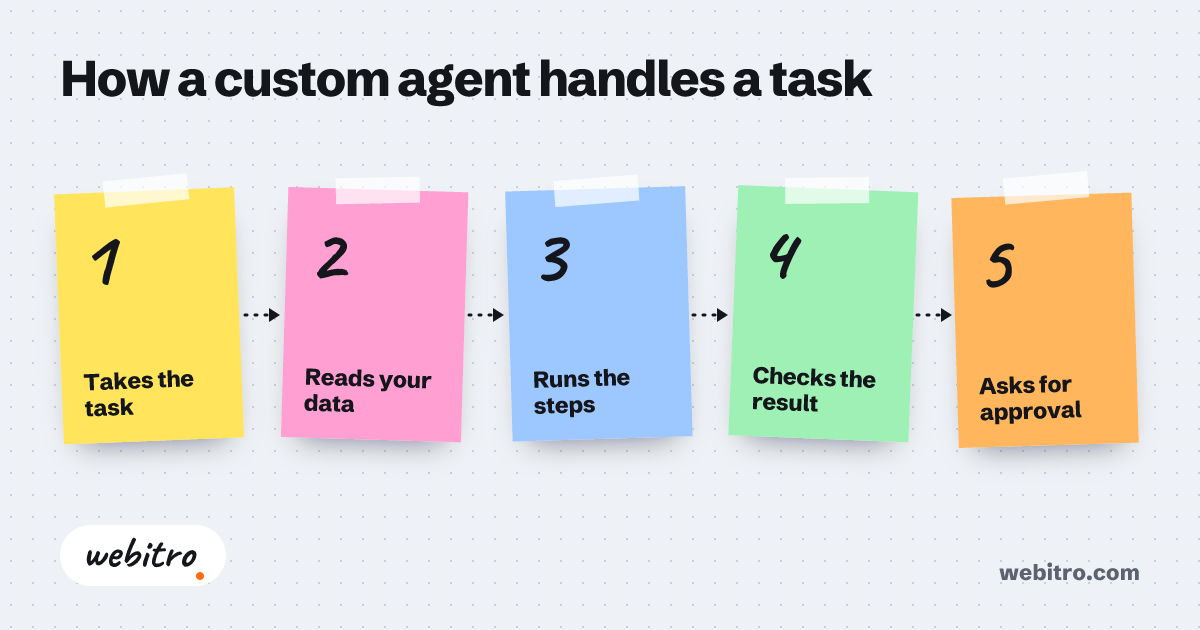
- An AI agent differs from a banking chatbot because it executes multi-step tasks across systems, not only replies inside a chat window.
- In banking agent projects, integration, data mapping and audit logging typically consume more effort than model selection.
- FCA-regulated firms need to explain automated decisions affecting customers, which makes human handoff and replayable logs part of the first build rather than a later phase.
- Running an agent in shadow mode alongside staff is the cheapest way to measure accuracy before granting write access.
Video summary of this article
Watch this video on its own page
Video transcript
The article explains where artificial intelligence agents fit in banking and how to build one.
A chatbot replies inside a chat window. An agent takes the next step and works inside limits you set. That reach brings risk, so permissions and review points matter.
The quickest wins sit in back office work with clear rules and high volume. Onboarding document checks send doubtful cases to a person. Payment queries and case triage suit agents, with human approval.
Build a small service around one allowed decision. Add read only data access and hard limits on changes. Log every step and test in shadow mode first.
Cost follows the number of systems, data quality and risk evidence. More systems and poor legacy interfaces multiply integration work before agent logic is written.
Platforms suit narrow tasks while a custom build fits core systems and approval rules. Use least privilege access, human approval for sensitive actions and replayable logs. Pilot one workflow in shadow mode with a kill criterion.
The article contains the full details and examples.
If the terminology is still fuzzy, our explainer on how AI agents work covers the gap between a tool-calling agent and a scripted bot.
What separates an AI agent from a banking chatbot?
A banking chatbot answers questions, while an AI agent takes the next step itself — pulling records, checking rules and finishing the task inside limits you set.
The difference is scope. A chatbot sits in a chat window and replies. An agent has tools: it can query a core banking system, open a case, draft a letter or flag a payment, then check whether the result actually worked.
That extra reach is what makes agents useful in retail and commercial banking. It is also what makes them risky. An agent that can move data can move the wrong data, so the real design work sits in permissions and review points as much as in the model.
Most teams we speak to already have a decent language model through a vendor. What they lack is the plumbing: clean access to account data, a policy layer that states what the agent may do, and a log that proves what happened. If the terminology is still fuzzy, our explainer on how AI agents work covers the gap between a tool-calling agent and a scripted bot.
Where do UK banks get value from AI agents first?
The quickest wins sit in back-office work with clear rules and high volume — document checks, payment queries and case triage — not in open-ended customer chat.
Start with the work your staff describe as repetitive but nerve-racking. Onboarding document checks are a common first step: an agent reads a passport or utility bill, compares the details with the application, flags mismatches and sends anything doubtful to a person.
Payment and reconciliation queries suit agents too. Instead of a shared inbox and a spreadsheet, the agent pulls the transaction, matches it to the reference and drafts the reply for a human to approve. Turnaround drops, and nobody loses the final say.
Other places we see early traction:
- Vulnerable-customer signals routed to a trained adviser
- Complaint intake sorted by product and severity
- Credit memos drafted from existing file notes
- Fraud alerts triaged before an analyst opens the queue
For the alerting side, this walkthrough of AI fraud detection software pricing shows how monitoring features change the scope of a build.
How is a banking AI agent actually built?
It is built as a small, auditable service — a model plus tools, permissions, guardrails and logging — wired into one or two systems at a time.
We start with the decision the agent is allowed to reach, not with the model. That single choice tells you which records it needs, which actions it may take and where a person must sign off. Everything else follows from it.
Next comes the tool layer: read-only database views, a small set of permitted API calls, and hard limits on what the agent can change. Anything touching money or a customer record goes through an approval step, even after launch.
Then the boring part that decides whether the project survives audit: logging every prompt, tool call and outcome, plus a replay path so a reviewer can reconstruct any case months later. Testing runs in shadow mode first, comparing the agent's choices against what staff did.
That is the work our AI agent development team does: scoping one workflow, building the tools and guardrails, then handing over something that runs without us.
What drives the cost of an AI agent for a bank?
Cost follows the number of systems the agent must touch, how clean the data is and how much evidence your risk team wants, far more than it follows model choice.
A single workflow reading one system is a modest project. Add a core banking platform, a document store and a case manager, and the integration effort multiplies before a line of agent logic is written. Legacy interfaces with poor documentation push it further.
Data quality is the quiet cost. If account records disagree across systems, the agent will surface that disagreement on day one, and someone has to resolve it. Budget for that mapping work rather than treating it as a surprise.
Risk and compliance evidence is the third driver. Replayable logs, approval screens, red-team testing and documentation for your model risk committee all take time, and they are not optional in a regulated firm. Our breakdown of what AI agent development costs sets out the same drivers in plain terms.
Custom build or off-the-shelf platform?
A platform gets you a working assistant in weeks, while a custom build earns its cost when the agent must live inside your own core systems and approval rules.
Vendor platforms are sensible for narrow, well-bounded tasks: answering staff questions from a policy library, or summarising tickets. You get value quickly and someone else carries the maintenance. The catch is that tenants share a roadmap, and your unusual approval chain rarely makes the list.
A custom build makes sense when the agent has to read from systems no vendor connects to, follow rules specific to your credit or onboarding policy, and produce evidence your auditors will accept. You own the code, the prompts and the logs.
Plenty of banks end up with both: a vendor tool for internal knowledge search, and one custom agent for the workflow that actually costs them hours. A middle path is to prototype cheaply, prove the numbers, then invest.
Which guardrails should be non-negotiable?
Insist on least-privilege tool access, a human approval step for anything that moves money or edits a customer record, and a log you can replay months later.
Treat the agent like a new starter with system access. It gets the minimum permissions needed for its one job, no standing access to production data it does not use, and a clear owner inside the business rather than only in IT.
Explainability has to be designed in. A reviewer should be able to see which records the agent read and why it reached a conclusion, because FCA expectations around Consumer Duty and operational resilience assume you can account for automated decisions affecting customers.
Personal data brings UK GDPR duties too: minimisation, retention limits and a lawful basis for anything the agent reads or stores. None of that is glamorous engineering, but it is what turns a demo into something your risk function will sign.
How do you run a pilot that survives scrutiny?
Pick one workflow, one system and one measurable outcome, run the agent in shadow mode beside staff, then compare accuracy and handling time before widening access.
Choose a workflow where the volume is steady and mistakes are recoverable. Onboarding document checks or payment queries fit that test. A pilot that touches lending decisions in week one will stall in committee.
Define the comparison before you start: how long the task takes today, how often it comes back as an error, and what staff think of the output. Then run the agent silently on live cases and score it against human decisions.
Set a review date and a kill criterion. If accuracy or handling time does not move, stop and say so. Teams that publish honest pilot results find the second approval far easier than the first.
That is the work our AI agent development team does: scoping one workflow, building the tools and guardrails, then handing over something that runs without us.
Frequently Asked Questions
Can an AI agent approve a loan or open an account on its own?
Not in any build we would recommend. It can gather evidence, draft the decision and prepare the paperwork, but a named person signs off anything that affects a customer's money or status.
How long does a banking agent project usually take?
One workflow reading one or two systems is typically a few months from scoping to supervised live use. Each additional system and each extra approval gate adds time, so we scope the first slice tightly.
Will it work with our old core banking system?
Usually, yes, but through a thin layer we build around whatever interfaces exist — database views, file drops or SOAP endpoints. That wrapper is often the largest single piece of the work.
What happens when the agent is unsure?
It stops and hands the case to a person with a short note on what it checked and what looked wrong. Confidence thresholds are tuned during the shadow-mode trial, not guessed at the start.
Do we need our own data science team to run this?
No. You need a product owner inside the business and someone in IT who can grant access. The evaluation work is mostly process knowledge, not machine learning.