Custom AI Voice Agent Development Cost UK: What Moves the Price
A custom AI voice agent is a phone assistant built around your own call flows, wording and systems rather than a rented template with your logo on it. It answers calls, qualifies enquiries and books appointments, then passes the awkward cases to a person. Nothing about it is off the shelf, so it is quoted per project rather than per seat.
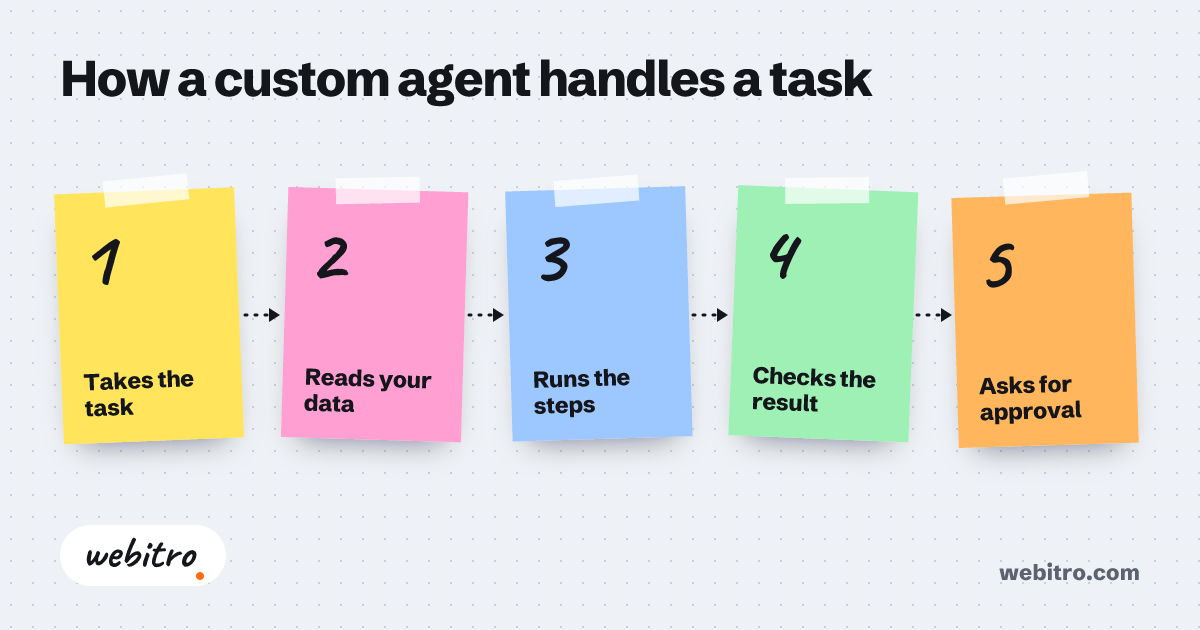
- Most of the cost sits in conversation design and system integrations rather than in the speech model itself.
- Running costs scale with call volume, because telephony, transcription and reply generation are billed per use.
- A single call type with one integration is the cheapest useful starting point for a voice agent.
- Retention rules and access controls have to be designed into the first version rather than added after launch.
Video summary of this article
Watch this video on its own page
Video transcript
This article explains what shapes the cost of a custom voice agent in the United Kingdom.
A custom voice agent is built around your own call flows, wording and systems. A full build covers conversation design, speech, telephony and every connected system. Testing runs on recorded and simulated calls before customers hear it.
Scope decides the price, including call types, integrations, languages and required accuracy. A single booking line is a small job, while a full switchboard is much bigger. Accuracy costs more when prices and stock levels must be correct.
Template voice tools answer generic questions cheaply. Custom builds earn their cost when calls depend on your pricing and records. Template tools can refuse or invent answers, which looks bad on a recorded line.
Running costs come from telephony minutes, speech processing, replies and support. Volume matters more than headcount, because every call is metered. A clinic with short calls differs from a long technical sales line.
A first working version usually lands in weeks rather than months. Start with one call type, measure resolved calls, then fund the next flow.
All details are in the article.
What does a custom AI voice agent build actually include?
A full build covers conversation design, speech recognition and voice output, the telephony link, and every system the agent reads from or writes back to.
On a real project we start with the calls you already get. Which ones eat your team's day? Which ones should end in a booking? That list becomes the specification, and it moves the price more than any technical choice.
From there we write the flows, the fallback lines and the escalation rules, then connect the agent to your calendar, CRM or order system. Testing runs on recorded and simulated calls before a single customer hears it.
You keep the flow documents, the prompt set and the test calls, so the agent can be maintained later without starting from scratch.
Voice output is chosen per brand: a neutral studio voice, a regional accent, or a cloned voice where the client holds the rights to use one. That choice affects both the feel and the licence cost.
What drives the cost of a custom AI voice agent in the UK?
Scope decides the price: the number of call types, the systems the agent must touch, the languages it speaks and how much accuracy the job needs.
Two quotes with the same headline can sit far apart. A single inbound booking line is a small job. A switchboard with order lookups, refunds and out-of-hours cover is a different animal.
- How many call flows there are, and how often they branch.
- Integrations: calendar, CRM, payments, ticketing.
- Languages and accents the agent must handle.
- Escalation rules and clean human handover.
- Reporting, recordings and admin screens.
We quote after a scoping call, because guessing produces either inflated budgets or unpleasant surprises three weeks in. Build costs and running costs are always shown separately, in pounds.
Accuracy is the quiet cost driver. If the agent must be right about prices and stock levels, it needs tighter testing, more guardrails and a human fallback that genuinely works.
Ready-made voice tool or a custom build?
Off-the-shelf voice tools handle generic questions cheaply, while a custom build earns its cost when calls depend on your pricing, your availability rules and your customer records.
Many UK businesses sensibly start with a plug-in voice bot or a simple phone menu, and for a handful of FAQ answers that is enough.
The break point comes when a caller asks something only your business knows: a delivery slot, a quote range, an account balance. Template tools either refuse the question or invent an answer, and both look bad on a recorded line.
If you want the wider picture of what a bespoke build involves, our notes on custom AI agent development are a fair starting point.
A custom agent costs more up front because someone has to model your rules properly. The payback shows up when the same agent can quote, book and escalate without a script rewrite.
What are the running costs after launch?
Live costs come from telephony minutes, speech-to-text and text-to-speech usage, model calls and whatever support level you choose.
Building the agent is one budget; operating it is another. Every call uses telephony minutes, transcribes audio, generates a reply and often writes to a system. All of that is metered.
Volume matters more than headcount. A clinic taking short repeat calls looks nothing like a sales line with long technical conversations, even when both have the same number of staff.
We hand over a cost sheet at launch showing what each stage of a call consumes, then monitor the first month together to catch waste early.
Support is the last line item. Some clients want monthly monitoring and tuning, others just want a number to call when something breaks.
How long does delivery take?
A first working version usually lands in weeks rather than months, and the schedule grows with each extra integration, language or call type you add.
The first release should be deliberately narrow: one number, one or two call types, one integration. That puts something answerable in front of real callers quickly.
Each addition afterwards is scoped on its own. A second language or a payment step is a defined piece of work, not a renegotiation of the whole project.
Where projects run late, the cause is usually a call script nobody owns or slow access to a client's systems. Neither has much to do with the model.
Plan a review two weeks after go-live. Real calls surface gaps that test calls never do, and that review is where the next phase gets priced honestly.
How do you keep the budget sensible?
Launch one call type, measure how many calls the agent resolves unaided, and fund the next flow only when the numbers justify it.
Ask for a fixed scope on phase one and a separate estimate for everything after it. Blended quotes hide the parts that grow.
Track containment, booking rate and handover quality from week one. If a flow is rarely used, leave it alone and spend elsewhere.
Our AI agent development service covers voice, WhatsApp, Discord and Telegram bots, so the same rules and records can serve more than one channel.
If you would rather talk it through first, call the studio on +90-551-980-16-46 and we will sketch the scope before anything is signed.
For a broader sense of how bespoke projects are priced, our breakdown of custom software development cost follows the same logic of scope, integrations and support.
Does data protection work add to the bill?
Recording calls and handling personal data adds design, consent and retention work to the build, so it belongs in the estimate from day one.
Voice work touches personal data by default: names, numbers, sometimes payment details. Where audio lives, how long it is kept and who can listen are design decisions, not paperwork.
Those decisions cost time in the build and save far more later. We write retention rules, access controls and caller notices into the first version rather than bolting them on.
It also shapes the architecture. A design that keeps recordings out of the model's reach is simpler to defend than one that stores everything forever.
Any supplier who says a voice project can skip this step is quoting for a problem, not a product.
What should a UK buyer ask before signing?
Ask what is included, who owns the prompts and recordings, what a call costs to run, and how handover to a human actually works.
Ask for the call list in writing, with the ones you are not buying marked clearly. Vague scope is the main reason voice projects drift.
Ownership matters too. Confirm that the flows, prompts and recordings belong to you, and that leaving does not mean starting again elsewhere.
Finally, test the handover yourself. Ring the number, ask something awkward, and see whether the person who picks up knows what was already said. You can also read more about the team behind these builds on our about page.
Frequently Asked Questions
How much does a custom AI voice agent cost in the UK?
It depends entirely on scope. One booking line with a single integration is a small project; a multi-department switchboard with order lookups is a much bigger one. We quote after a scoping call and always show build and running costs separately.
Can you give a fixed price rather than a range?
Yes, once the call types and integrations are written down. Phase one can be fixed; anything added afterwards gets its own estimate so you can decide later.
Do we have to replace our phone system?
Usually not. The agent sits on your existing number or a new one, and calls can be forwarded to your team whenever it is unsure or the caller asks for a person.
How quickly can a voice agent go live?
A narrow first version takes weeks, not months, provided someone on your side can approve the call script and grant access to the systems involved.
What happens to call recordings?
They are kept according to the rules set during the build, with access limited to named people and a clear deletion point. That is agreed before launch, not after.