What a Custom AI Web Scraping System Development Company Actually Builds
A custom AI web scraping system is software built around one specific data-collection job: it reads pages you do not control, uses a language model to interpret messy layouts, and hands back clean records your team can act on. It is not a browser extension or a downloaded template. Someone writes the fetchers, the schema and the checks around your exact sources, and that is what a custom AI web scraping system development company is selling.
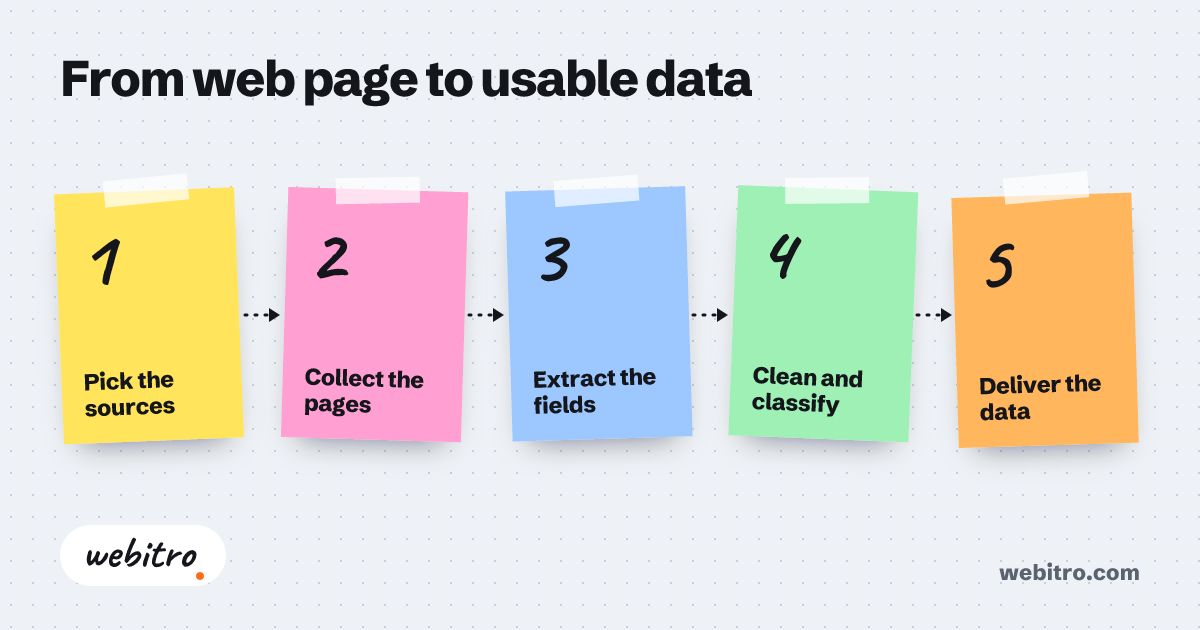
- A custom AI scraping pipeline is typically split into fetching, extraction, validation and delivery layers, so a layout change touches one layer rather than the whole system.
- Selector-based scrapers tend to fail silently after a site redesign, returning empty fields without raising an error.
- Running an extraction schema against a sample that a human already labeled produces a measurable error rate instead of an impression of accuracy.
Video summary of this article
Watch this video on its own page
Video transcript
This article explains what a custom artificial intelligence web scraping system actually includes and how it is built.
It pulls specific data from websites you do not own and returns structured records. A model reads messy layouts so field names and layouts stop being the problem.
Off-the-shelf tools break when pages change often or sit behind a login. A script can keep running and quietly return empty fields without an alert.
The pipeline keeps fetching, extraction, validation and delivery as separate layers. A layout change updates one extraction prompt or adapter while records keep flowing.
Cost follows source count, source variety, access limits and output requirements. Human review also affects cost because some output needs a person to sign off.
Every record carries where it came from and when it was collected. Running the schema against a labeled sample gives a measured error rate. High-stakes work keeps a person in the review loop.
The full details are in the article.
What does a custom AI web scraping system actually do?
It pulls specific data from websites you do not own, interprets the page with AI, and delivers the result as structured records instead of raw text.
The job is narrow by design. You name the pages and the fields — product names, prices, availability, addresses, review counts — and the system returns those fields, on a schedule, into a table or file your team already uses.
The AI part handles what fixed rules cannot. One site writes "2 bed / 1.5 bath," another writes "2BR, 1.5BA," a third buries it in a description. A model reads all three the same way, so field names and layouts stop being the problem.
Output is boring on purpose: a database row, a CSV, an API response, or a message in a chat thread. The interesting work happened upstream, where the page got parsed.
When do off-the-shelf scraping tools stop working?
They break down once the pages change often, sit behind a login, mix text with images, or need judgment about what a field means.
Most teams start with a scraper that works on day one and fails by week six. A template changes, a modal appears, prices render after load. The script keeps running and quietly returns empty fields — the worst kind of failure, because nothing alerts you.
Other limits arrive earlier. Logged-in dashboards need session handling. Pagination behind a "load more" button needs a real browser. And any page where a person has to decide "is this the same product?" needs a model, not a CSS selector.
A useful test before you call anyone: could you hand this task to a temporary hire with a laptop and clear instructions? If yes, a custom system can probably do it. If the answers depend on taste, negotiation or a phone call, it probably cannot.
How is the pipeline put together?
We keep four layers separate — fetching, extraction, validation and delivery — so a failure in one never quietly poisons the rest.
Splitting the work is not architecture for its own sake. It is what makes the system cheap to repair later.
- Fetching. Headless browsers, session rotation and retries. This layer has one job: get the HTML or JSON.
- Extraction. A model reads the page against an agreed schema and returns typed fields rather than a wall of text.
- Validation. Type checks, range checks, duplicate detection. Anything that fails goes to a review queue, not the main table.
- Delivery. A database, a CSV drop, an API endpoint, or a message into Slack or WhatsApp.
When a layout changes, the fetch layer keeps working while one extraction prompt or adapter gets updated. Records keep flowing. Nobody rewrites the whole thing over a redesigned product card.
What drives the cost of a custom scraping build?
Cost follows the number and hostility of your sources, how much the output must be normalized, and how much human review the result still needs.
No one sensible quotes a number before looking at the sources. What can be scoped is the shape of the job, and four things move it most.
Source count and variety come first. Five pages built by the same company are one problem. Five pages from five companies are five problems. Access comes next: an open catalog is cheap to read; a portal behind a login with rate limits is not.
Then output requirements. Do you want raw text, or records matched against your own SKU list? Matching is real work. Last is human review — how much of the output needs a person to sign off before it is trusted.
If you are weighing a build against a subscription, our breakdown of custom software development cost covers those same variables at project level.
How long does a build take, and how does it ship?
The first working version arrives early and covers one source, then scope widens in visible stages instead of one big delivery at the end.
We start with one source and the fields you care about most, running on a schedule and writing into a real table. You look at actual output and tell us what is wrong. That conversation is worth more than a spec document written in advance.
From there it grows: more sources, better matching against your own catalog, alerts when a page changes shape. Staged delivery matters because the hard part is rarely the first page. It is the tenth one nobody warned us about.
Monitoring ships with the system rather than as an upsell. Sites change without telling you, and a scraper nobody watches is a scraper that silently rots.
How do you keep the extracted data accurate?
Accuracy comes from traceable records and a scored sample, so you get a measured error rate instead of a feeling that the numbers look fine.
Every record carries where it came from and when. When a figure looks wrong, we trace it back to the exact page and the exact extraction that produced it — no guessing about which run went sideways.
We also run the same schema against a sample a human has already labeled. That produces a real error rate. For pricing and inventory work, spot-checking a few hundred rows is usually enough to surface systematic mistakes before they reach anyone's spreadsheet.
Where the stakes are high — money, contracts, listings that trigger action — a person stays in the loop. Full automation is not the goal. Automation with no review path is how bad data gets into a decision.
For jobs that need judgment across many sources, the approach in custom AI agent development is where those review steps usually get wired in.
Where does the data go once it is collected?
It lands wherever your team already works — a database, a dashboard, or a chat message that reaches someone before they think to check a report.
A finished system needs a home. Sometimes that is a scheduled job and a table your analysts query. Other times it is a notification: a competitor drops a price and the alert lands in a WhatsApp thread within minutes.
That is where our bots work fits. The same studio builds WhatsApp, Discord and Telegram bots that answer questions, take bookings and push announcements, so scraped output can reach people where they already are instead of in a tab nobody opens.
Everything described here is what we build under web scraping services, from a single catalog to a multi-source pipeline with review queues.
What should you send before the first call?
Send two or three example URLs, the fields you need from each, how often you need them, and where the data should end up.
That is enough for a useful first conversation about what is easy, what is not, and what the build realistically involves. Screenshots help. A sample of the output you wish you had helps more.
If part of your workflow is still scripted rule by rule, the comparison of AI automation vs RPA explains where each approach holds up and where it quietly stops scaling.
You can reach the studio at +90-551-980-16-46, or start from our packages if you want to see how fixed-scope work is structured before we talk.
Frequently Asked Questions
How much does a custom AI web scraping system cost?
It depends on how many sources you need, whether they sit behind a login, how much the output must be matched to your own catalog, and how much human review stays in the loop. Send a few URLs and the fields you want, and you get a scoped answer instead of a range pulled from thin air.
Can it handle sites that need a login?
Yes, when you have legitimate access to that data. We build session handling and respect rate limits, but we do not break access controls. If your account is the one being used, the system logs in the same way a staff member would.
Is this different from buying a scraping API?
APIs are built for the average page and charge per request. A custom system is built for your awkward edge cases — the variant names, the missing fields, the page that needs a click before it loads. You also keep the code and the schema.
What happens when the target site changes its layout?
Usually one extraction prompt or adapter gets updated while the rest of the pipeline keeps running. Monitoring is what tells us it happened; without it, you find out weeks later from a spreadsheet full of blanks.
Do we need AI for every part of the pipeline?
No. Fetching and validation are better as plain code — faster, cheaper, predictable. The model earns its place only where a page needs interpretation, like reading inconsistent product names or pulling a spec out of free text.