Generative Engine Optimization: How to Dominate AI Search
Generative engine optimization is the work of getting your business named inside AI-generated answers — the summaries ChatGPT, Google AI Overviews, Perplexity, and Copilot produce instead of a list of links. The goal is not a ranking position. It is being the source a model quotes, summarizes, and recommends when someone in your market asks a buying question.
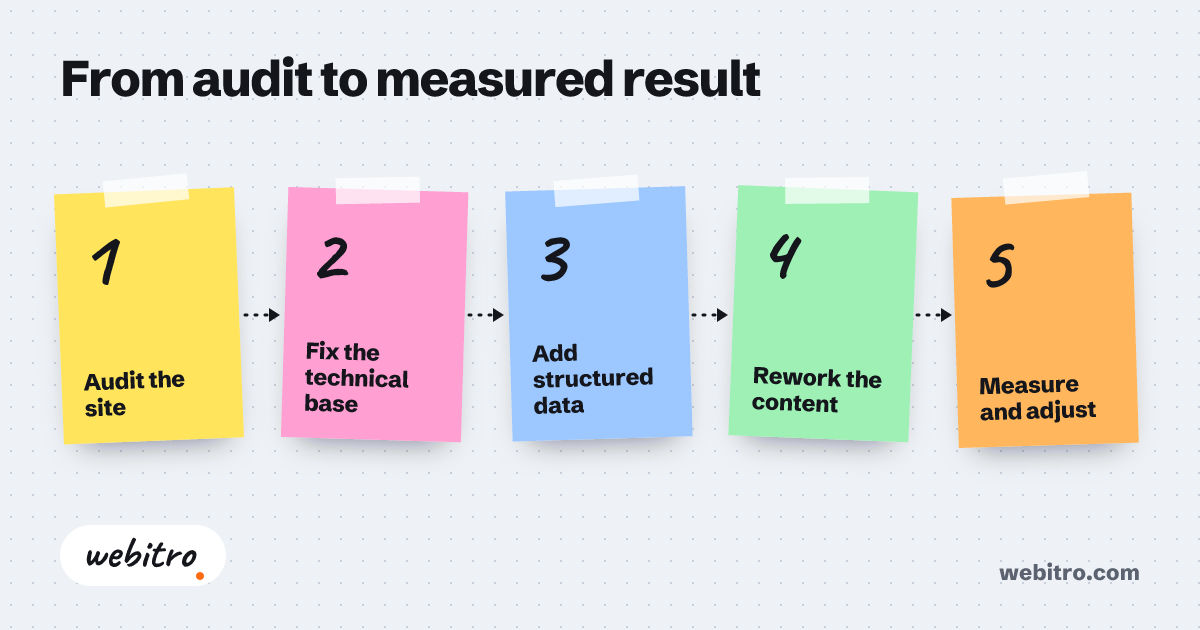
- Generative answers cite only a handful of sources per response, so a page that is never retrieved cannot be cited regardless of its traditional ranking.
- Original data and first-hand process detail are the parts of a page a language model cannot regenerate on its own, which makes them the strongest citation assets.
- Inconsistent service descriptions across a site, directories, and social profiles weaken entity recognition and reduce how often a brand is cited.
Video summary of this article
Watch this video on its own page
Video transcript
Generative engine optimization means getting named inside AI generated answers rather than chasing a link ranking.
GEO shifts the competition from ranking a link to earning a citation inside an answer. Generative answers compress ten positions into a handful of citations. It sits on top of technical SEO, so fix indexing first.
AI search engines cite sources they can retrieve, parse, and verify quickly. A page that never gets retrieved cannot be cited. A statistic confirmed on your site and elsewhere is safer to repeat.
Open each important page with a plain language answer of one or two sentences. Use headings that mirror real questions and add organization, service, and FAQ schema.
Models produce the generic version of your topic for free. What they cannot invent is your data, timelines, and pricing logic. Publish the process, not just the promise.
Rank trackers tell you almost nothing about generated answers. Keep a fixed list of buying questions and check them monthly. A mention without a click still sends people to search your name.
The full detail is in the article.
If you want the technical side laid out step by step, our breakdown of AI search optimization services covers how retrieval, indexing, and citation checks fit together.
What Does Generative Engine Optimization Actually Change?
Generative engine optimization shifts the competition from ranking a link to earning a citation inside a generated answer.
Classic SEO competes for ten positions on a results page. Generative answers compress that into a handful of citations, sometimes just one. If a model names three vendors and you are not among them, your page-one ranking is worth far less than it used to be.
That changes the work itself. You still need crawlable pages and real authority, but you also need sentences a model can lift without distorting them, entities it can disambiguate, and enough corroboration elsewhere that the claim feels safe to repeat.
In practice, GEO sits on top of technical SEO rather than replacing it. Fix indexing first, then shape the content. Skipping the first part and jumping straight to keyword tweaks is the most common way budgets get wasted.
How Do AI Search Engines Decide Which Sources to Cite?
AI search engines cite sources they can retrieve, parse, and verify quickly, so clarity and outside corroboration outweigh keyword density.
Retrieval comes first. The system searches an index, pulls candidate passages, then generates an answer with attributions. A page that never gets retrieved cannot be cited, no matter how well it reads.
After retrieval, models weigh clarity, recency, and agreement across sources. A statistic that appears on your site, in a trade publication, and in a directory is safer to repeat than one nobody else confirms. Independent mentions do a lot of quiet work here.
The practical consequence is that your on-site copy and your off-site footprint have to say the same thing. Mismatched service descriptions confuse the entity and cost you citations you would otherwise earn.
Which Page Structure Makes Your Content Quotable?
Pages that state a short direct answer up top, then support it with clean headings and structured data, get pulled into AI answers far more often.
Open each important page with a plain-language answer, one or two sentences, before any explanation. Models reward passages that survive extraction intact. If your point arrives in paragraph six, it usually does not arrive at all.
Use headings that mirror real questions. "How much does a custom chatbot cost?" beats "Investment considerations" every time, because the heading itself signals the passage it introduces.
Add organization, service, and FAQ schema. Keep lists and tables in HTML rather than images. Anything rendered by a script that crawlers skip is effectively invisible to the retrieval step.
Name things explicitly, too. Write "Webitro Software Studio" rather than "we", and describe services with the words buyers actually type. When you would rather hand the whole build over, our generative engine optimization services cover the audit, the page restructuring, and the bots that keep your answers consistent.
What Kind of Content Earns Repeated Mentions?
Original numbers, first-hand process detail, and honest comparisons give models material they cannot generate on their own.
Models produce the generic version of your topic for free. What they cannot invent is your data: failure rates from your own projects, timelines you have measured, pricing logic you can defend when a client pushes back.
Comparisons work well too. A page that explains when a custom build beats an off-the-shelf tool, and when it does not, gets quoted in both directions — including by people who eventually pick the cheaper option and remember who was honest about it.
Publish the process, not just the promise. A short walkthrough of how a project actually runs gives a model concrete steps to summarize, and steps are exactly what buyers ask about. Drafting help is a separate decision from strategy, and our notes on the best AI tools for SEO content explain where automation earns its place and where it flattens your voice.
Where Do Chatbots and Bots Fit Into AI Search Visibility?
Conversational bots help visibility indirectly by keeping your public answers specific, current, and consistent across every channel a crawler can read.
A chatbot on your site or a messaging channel answers questions in your own language, at length, over and over. That interaction produces text about your business that is concrete and aligned — the kind of material retrieval systems like to work with.
We build WhatsApp chatbot AI plus Discord and Telegram bots that answer questions, take bookings and orders, send announcements and manage your community. Watch a dental practice in Austin handle insurance questions at nine at night and you see the pattern: same wording, same accuracy, no drift.
There is a direct benefit and an indirect one. Direct: faster service and fewer missed bookings. Indirect: a steady stream of well-phrased answers that reinforce how your business describes itself everywhere else.
We walk through the setup in our guide to WhatsApp chatbot AI, including how booking and order flows are handled.
How Do You Measure GEO Progress Without Vanity Metrics?
Track citations inside AI answers, referral traffic from AI surfaces, and how often your own phrasing reappears in generated responses.
Rank trackers tell you almost nothing about generated answers. Instead, keep a fixed list of the buying questions your customers actually ask and check them monthly in ChatGPT, AI Overviews, Perplexity, and Copilot. Record whether you appear, which competitors do, and what phrasing surrounds you.
Then watch referral traffic from AI surfaces in analytics, and log brand search volume. Mentions that never produce a click still move people to type your name into a search box later that day.
One more signal: when a model paraphrases your framing back to you, the citation is doing its job. Note which pages produce that and write more like them. If you want the technical side laid out step by step, our breakdown of AI search optimization services covers how retrieval, indexing, and citation checks fit together.
Which Mistakes Keep Good Sites Out of AI Answers?
Hiding answers behind scripts, burying facts in PDFs, and describing yourself three different ways keep strong pages out of generated citations.
The most common failure is a page that answers nothing. Long introductions, stock photos, and vague benefit lists give a model nothing to quote, so it quotes the competitor who stated the answer plainly.
The second is invisibility. Answers locked in JavaScript, key facts trapped in a PDF, and pages with no internal links are hard to retrieve. Crawlers are patient, but they are not psychic.
The third is inconsistency: different descriptions of the same service across your site, your directory listings, and your social profiles. Pick one wording and hold it everywhere. Models resolve entities by agreement, and disagreement reads as uncertainty.
When you would rather hand the whole build over, our generative engine optimization services cover the audit, the page restructuring, and the bots that keep your answers consistent.
Frequently Asked Questions
Is generative engine optimization different from SEO?
It builds on it. Technical SEO gets you retrieved; GEO shapes what gets quoted once you are retrieved.
Do I need special markup to appear in AI answers?
Organization, service, and FAQ schema help, but plain, well-structured HTML answers matter more than any single tag.
Can a small business compete with big brands in AI answers?
Yes, when it owns narrow questions. Specific first-hand detail on a tight topic beats generic coverage from a large site.
Does a chatbot actually help visibility?
Mostly indirectly. It keeps your public answers consistent and gives crawlers more specific text to work with.
How long before citation checks show movement?
It depends on crawl frequency and how much of your site needs rewriting, so we set expectations after the audit rather than before it.