AI Agent Development: What It Takes to Build Agents That Do Real Work
AI agent development is the work of turning a language model into a system that can pursue a goal, call real tools and finish a task inside your own software. The model is only the engine; the value sits in the tools, rules and tests wrapped around it. This page covers the full path: what to build, which platforms to consider, how agent teams are coordinated, what drives cost and how to hire without getting a demo that falls apart in week two.
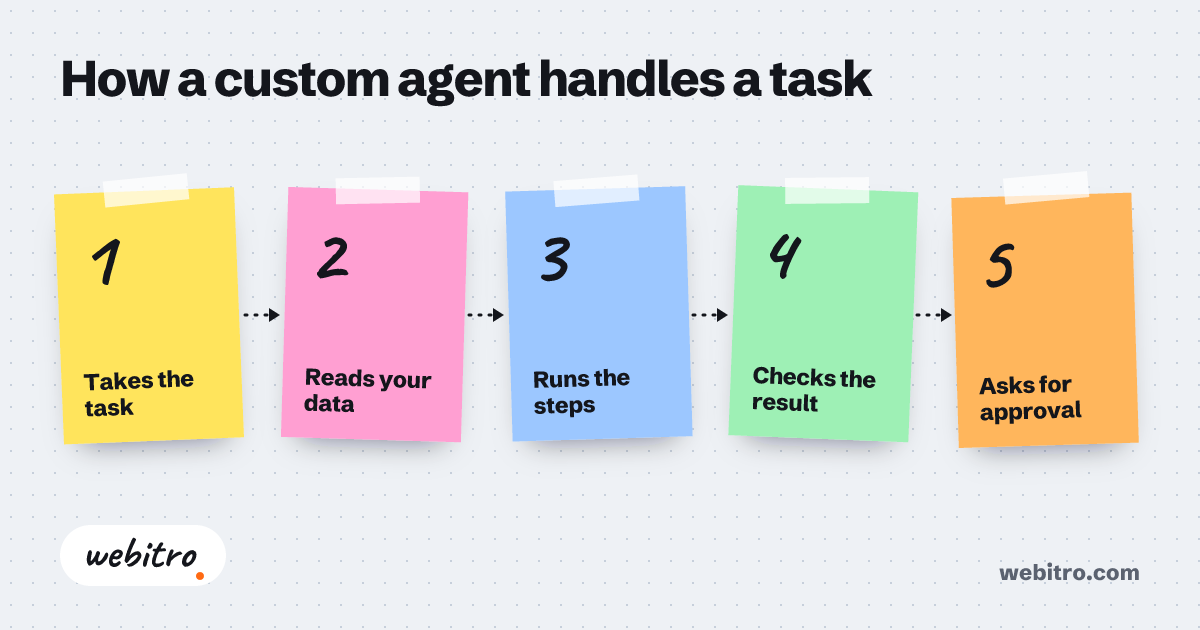
- Agents usually fail because of tool error handling and permission scope, not because the underlying model reasons poorly.
- A fixed evaluation set built from real past requests shortens iteration more than extra prompt tuning does.
- Custom development becomes the cheaper path once the agent must call internal systems through APIs that managed builders do not expose.
Our AI agents explained article takes the same picture apart piece by piece if you want the vocabulary before you start scoping.
What AI agent development actually means
AI agent development is the engineering work that turns a language model into a program able to take a goal, choose steps, call tools and keep going until the job is done or a person must approve something.
An AI agent is not a chat window with a personality bolted on. It reads a goal, decides which step comes next, calls real systems such as your CRM, calendar or payment API, checks the result and repeats until the task closes.
That gap explains why two quotes for the same idea can look nothing alike. One team writes a prompt and a wrapper. Another maps your tools, defines what the agent may touch and builds a test set from real requests before anyone runs a demo.
Strip away the marketing and four jobs remain: describe what the agent can do, give it reliable tools, constrain what it may change, and prove it still behaves when the input is messy.
Chat agents, task agents and autonomous agents
A chat agent answers questions and hands off, a task agent completes one defined job end to end, and an autonomous agent keeps working toward a goal with little supervision, each carrying a different level of risk.
Most businesses that ask for an agent actually need the middle option first. A task agent owns something narrow and repeatable: qualifying an inbound lead, drafting a contract summary, posting a scheduled announcement to a community.
Chat agents are the most visible and the easiest to oversell. They are genuinely useful when the conversation is where the customer already is, which is why WhatsApp, Discord and Telegram keep coming up in scoping calls.
Autonomy is a dial, not a switch. You can let an agent read, draft and queue actions while a person presses send. Before you hand over a budget and a login, look at what oversight autonomous AI agents actually require in production.
The build loop: run the task by hand first
Every agent worth shipping starts as a manual run-through of one narrow task, because those transcripts show which tools, rules and fallbacks the agent truly needs.
Pick one task that eats hours every week and gather real requests for it: old support threads, form submissions, order messages. Real input beats invented examples, because it arrives with typos, half sentences and missing context.
Then do the work yourself with the model in the loop. When it guesses instead of asking, when it invents a record, when it needs a policy you never wrote down, note it. That list becomes your specification.
Only after that do you write code. Each tool gets a typed input, a validation step and an error path. The loop gets retries, timeouts and a fallback that routes to a human instead of looping forever.
This is where custom AI agent development earns its keep: your tools are yours, so a prompt alone will not close the gap.
Platform or custom build: choosing a starting point
Start on a managed platform when the task is standard and your data already sits in a supported store, and go custom when the agent must call your own systems or follow rules no builder exposes.
Managed builders such as Vertex AI Agent Builder get you a working agent quickly. You attach a datastore, ground the answers in your documents, define a few tools and publish. For internal knowledge search, that path is hard to beat.
The trade-offs show up later. No-code builders limit how you handle failures, how you log tool calls and where data is stored. Porting away is real work once your team depends on the thing.
A practical compromise: prototype on a platform to prove the task is worth automating, then rebuild the parts that need depth. Our AI agent development service builds WhatsApp chatbot AI plus Discord and Telegram bots that answer questions, take bookings and orders, send announcements and manage your community.
When one agent is not enough
Splitting work across several agents pays off when a job needs clearly different skills or data access, and it adds coordination cost the moment two agents must agree on a shared state.
The common pattern is an orchestrator that routes and a handful of specialists that do one thing well. Research, drafting, checking and posting each get their own instructions, their own tools and their own limits.
What breaks first is the handoff. Give every agent a fixed message format with fields it must fill, and validate that format before the next agent sees it. Free-form chatter between models burns tokens and produces quiet misunderstandings.
Multi-agent orchestration gets interesting once a single agent already handles its own task reliably. Before that, extra agents mostly add failure points.
The message contract matters more than the model choice, and what actually happens when AI agents talk to each other is structured handoff, not conversation.
What drives the cost of an AI agent
Cost tracks scope, meaning integrations, data quality, review steps and who maintains the system, far more than it tracks which model sits underneath.
Model usage is rarely the biggest line. The expensive parts are messy: a CRM with no clean record IDs, a booking system with no API, a document pile that has never been indexed, a policy that lives in one person's head.
Then come the running costs. Someone has to watch accuracy, refresh prompts when a tool changes, review flagged conversations and pay platform or hosting fees on top of per-call model charges.
We break the drivers down in our piece on what AI agent development cost really depends on, and the same logic applies to retainers, which is why AI automation pricing is usually quoted monthly per running system.
Agency, in-house team or freelancer
Hire an agency when you need the whole path from scoping to a monitored system in production, and build in-house only if you already have engineers who will own the agent after launch.
An AI automation agency typically owns discovery, build and the monitoring afterwards. That suits companies without a machine learning team, as long as the contract covers code ownership, documentation and a clean handover.
Freelancers can be excellent for a narrow, well-specified agent. They struggle when the work needs several integrations plus ongoing operations, and handover is often the first thing to slip.
In-house makes sense when the agent is close to your core product and will change every month. Even then, the first build often goes faster with outside help. Ask any AI agent development company for the evaluation set, the deployment plan and the exit terms before signing anything.
Reliability and permissions: what keeps an agent alive
Agents fail on messy input and permission mistakes far more often than on reasoning, so a replayable test set, scoped credentials and a human approval step are the real durability work.
Build an evaluation set from the beginning: real requests with the correct outcome written next to them. Run it after every change. Without that set, improvements are guesses and regressions arrive silently.
Log every tool call with inputs, outputs and the decision that led there. When something goes wrong, you want to replay the exact sequence rather than read a vague summary of what the agent thought it did.
Permissions deserve the same care. Give each tool the smallest credential it needs, and route anything that spends money, deletes records or messages customers through a confirmation step. A well-scoped agent that asks once beats an eager one that apologises later.
Reusable playbooks: coding agents inside the build
Coding agents speed up development only when the repository carries repeatable instructions, which is why we package our conventions as short, versioned playbooks instead of retyping prompts.
Half of agent work is not the client's agent at all. It is the assistant that helps us write, test and refactor the code behind it. That assistant is only as good as the context it gets on every run.
Claude Code Skills are a good example: short, versioned instructions that keep an agent's output consistent across an entire project, from how we structure tools to how we name tests.
The habit transfers to clients too. Any team running agents in production ends up writing down its rules once and loading them every time, because consistency beats clever prompting.
A first agent that survives contact with users
The safest first agent owns one repetitive, low-risk task with a clear handoff to a person, so you can measure accuracy before widening its access.
Choose a task with visible volume and low blast radius: answering recurring product questions, capturing booking details, summarising incoming documents. Keep a person in the loop wherever money or reputation is at stake.
Launch on one channel, not five. Whatever your customers already use, be it WhatsApp, Discord, Telegram or a form on your site, is the right place to start, because the agent's value only shows up inside a real conversation.
Then review the transcripts weekly. Fix tool descriptions before you touch the prompt, and note where people abandon the agent, since that gap usually points to the next feature.
Our AI agent development service builds WhatsApp chatbot AI plus Discord and Telegram bots that answer questions, take bookings and orders, send announcements and manage your community.
Frequently Asked Questions
Do I need a custom agent or can I use a no-code builder?
If the task is standard and your content already lives in a document store, a managed builder will get you there. Custom work starts paying off once the agent has to talk to systems that builders do not support, or when you need real control over logging, failure handling and where data sits.
How long does building an agent take?
It follows scope, not model choice. A single-channel agent using one or two APIs moves quickly, while anything touching messy internal data, several approval steps or multiple teams takes considerably longer before it is safe to run unsupervised.
What does an AI agent cost to run each month?
Expect model usage, hosting or platform fees, and ongoing maintenance. The last one is the part people forget, because tools change, documents go stale and accuracy drifts unless somebody owns the system.
Can an agent work inside WhatsApp or Discord?
Yes, and that is often the smarter first move, since customers are already there. We build WhatsApp chatbot AI alongside Discord and Telegram bots that answer questions, take bookings and orders, send announcements and manage your community.
How do I know the agent is actually working?
Keep a set of real past requests with the correct outcome next to each one, and re-run it after every change. If the score holds and transcripts read cleanly, the agent is doing its job.